
Companies that don’t have winning aspirations and who don’t leverage a range of competitive advantages will not survive in the longer-term and are wasting the time of their people and the capital of their shareholders.
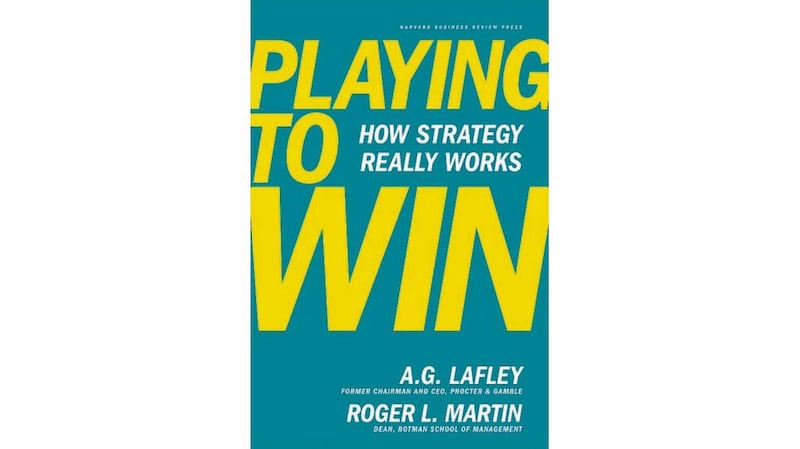
That’s the view of Roger Martin, co-author with AG Lafley of a major new book on strategy Playing to Win – How Strategy Really Works.
Lafley, a long-time collaborator with Martin, is a former president and CEO of Procter Gamble and is credited with transforming the corporation, quadrupling profits and adding about $100 billion to its value.
Martin is dean of the Rotman School of Management in Toronto, author of a number of well-regarded books including Fixing the Game and The Design of Business and has been cited by Business Week as one of the 10 most influential business professors in the world.
Based on their work at PG and elsewhere, Martin and Lafley say that strategy is often misunderstood. It is in essence a set of choices about winning and a company needs to define its strategy around five questions:
What is the winning or motivating aspiration of the corporation?
Where will you play?
How will you win in the chosen playing field?
What capabilities must be in place?
What management systems are required?
They distinguish between those who seek to merely participate in a market, and those who want to dominate one.
In the book, they site the example of General Motors’ decision to launch the Saturn motor brand in 1990 to compete in the small-car market as a classic “playing to play” strategic error.
Saturn was GM’s answer to the Japanese imports that threatened to dominate the lower end of the market. It was a defensive strategy design to protect what remained of the ground they were losing.
Some 20 years on and by analyst estimates $20 billion in loses later Saturn is gone. The brand was axed in 2010.
“It died because its aspirations were too modest and didn’t involve the right where to play and how to win choice, capabilities and management system,” Martin told The Irish Times.
“There is simply no point in deciding to compete with an incumbent with the same proposition. “
In essence, companies have two strategic choices – either to find a way to be significantly cheaper and to destroy the competition on price or to come up with an innovative and compelling proposition.
“A big mistake companies make is to look at industry norms and to assume that’s the way it has to be. You can always modify your ‘where’ and those choices make all the difference in the world,” he says.
A classic PG example, he cites, is Olay, once seen as a jaded brand aimed at older women. It skilfully repositioned itself for women in their mid-30s, who were experiencing wrinkles for the first time and its “Love the skin you’re in” slogan suggested an alternative to cosmetic surgery.
It unleashed a whole new profitable demographic and transformed the fortunes of the brand.
Winning aspirations
Crucially, he says, there were three aspirations. Firstly, there was market share leadership in North America, $1 billion in sales and a global share that put the brand among market leaders.
Secondly, revitalising Olay was seen as a pillar for beauty and hair care. Estab- lishing and maintaining leadership of a new “masstige” segment, positioned between mass and prestige, was a third proposition.
Clarity about the winning aspirations meant that action at the brand, category, sector and corporate level were directed at delivering against that ideal, he observes.
A G Lafley, he notes, falls into that category of pragmatic leaders who when faced with two apparently contradictory choices, can find a third way.
On assuming leadership with PG, the choice was whether to hunker down and satisfy the financial markets or to be bold and innovative, spending heavily on RD and risking poor financial performance in the short-term for long-term gain.
A key part of Lafley’s solution was to collaborate with outsiders – colleges and entrepreneurs, for example – driving down the cost of innovation.
“It’s hard to draw lessons from the actions of leaders because most of their actions are driven by their specific circumstances, but this trait of finding a blend is one that I have seen many times in effective leaders.”
Martin worked with Michael Porter in the 1990s and has a keen appreciation of what’s required to achieve enduring competitive advantage in a market.
“Simple competitive advantages like price or scale are not enduring advantages as someone can come along and trump you there easily.
“If you want to protect your position, you need a range of advantages including areas like brand and innovation.”
Innovation is crucial, he says, but he fears that there is not enough of it in business at the moment with an over-reliance on big data and analytics.
“Innovation is ever more challenged as the whole emphasis at the moment is on the evidence-based side – the notion that crunching all the numbers will provide you with the answers. The problem with that is that you can’t prove new ideas.”
Martin is a strong proponent of collaboration between the creative innovative disciplines and the more logical mathematical and engineering disciplines.
Predictable formula
In an earlier work The Design of Business, he suggests that successful business innovation evolves in three stages.
The first is the recognition of a mystery, the second involves a heuristic or “rule of thumb” that suggests a solution to a problem while the final phase is the development of an algorithm, a predicable formula that can be used to scale a product or business.
That ability to merge the creative with the logical could be the salvation of the western world in its bid to compete against the increasingly powerful forces of the east, he says. Knowing where to play, in other words.


