
An Garda Síochána reflects the best and worst of our public service. The moment has come for a review of the force
If anything positive can flow from the callous murder of Det Garda Adrian Donohoe, it has to be the outpouring of public sympathy and support for the Garda Síochána that has followed.
On the mercifully rare occasions before when a garda has been murdered in the line of duty it has been this way.
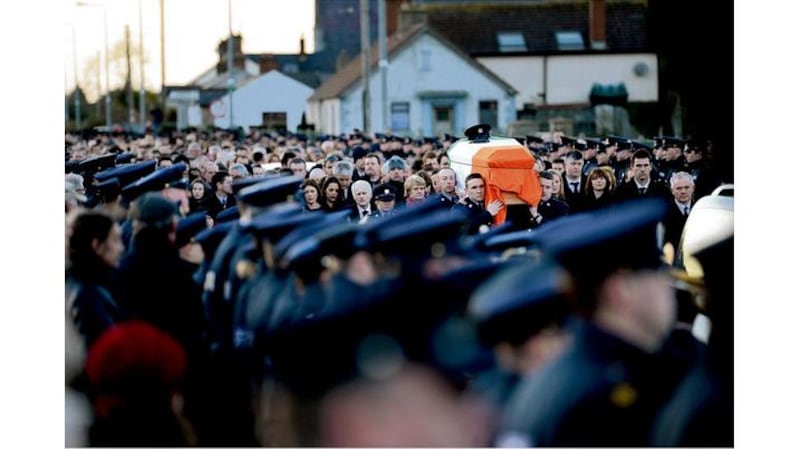
In April 1970, when Dick Fallon became the first garda to be killed on duty for 26 years, the crowds that lined the streets for his funeral were likened to those that had turned out to see President John F Kennedy in 1963.
The murder of Adrian Donohoe has shocked and saddened communities across the country, as did the deaths of the 12 other members murdered in the line of duty since 1970. The sense of widespread mourning, led by the President and other officers of State, has been palpable.
As a race we are not particularly noted for our love of regulation. Yet we hold the Garda Síochána close to our hearts in a relationship that would be considered somewhat unusual between police and people in many countries.
The roots of the relationship go back to decisions that were taken in 1922. The force was imbued with a spirit of proud Irishness as the new State asserted its identity. It was to be nonpolitical, unarmed and drawn from the people.
Imaginative, if unsuccessful, attempts were made to have it operate through the Irish language. Ranks and functions were designated in Irish. Its youthful members were to be hugely engaged with sport – Gaelic football, hurling, athletics, boxing.
Eoin O’Duffy, commissioner from 1922 to 1932, declared, “The Civic Guard is Irish in thought and action.”
It is a truism that a society’s values and standards are reflected in its police. This is particularly true where policing is by the consent of the people. The police organism will attune itself to the community’s needs and priorities. Therein lies the compact that defines the relationship.
That relationship here has survived many vicissitudes down the decades. As early as 1926, a crisis arose when the minister for home affairs, Kevin O’Higgins, demanded that O’Duffy discipline gardaí in Waterford who had rampaged against prisoners after two gardaí had been murdered. O’Duffy threatened to resign. O’Higgins called his bluff and the offending gardaí were dealt with.
Controversies
Each decade has brought some controversy: the “Heavy Gang”, the fingerprints scandal and the sacking of a commissioner; illegal phone tapping and the “Kerry babies” fiasco; the breakdown in the Donegal division that led the Morris tribunal to warn that the Garda Síochána was “in danger of losing its character as a disciplined force.”
Many of the cliches about the gardaí are true. Like most other closed groups, they are not very good at investigating themselves. They display all of the characteristics of a closely knit family; they may squabble among themselves but they will instantly close ranks against outsiders. They have their share of bullies and louts. There are gardaí, as there are those in other professions, who abuse their authority. Some are insubordinate and lazy. Supervision is too often lax.
Yet the strong bonds between the gardaí and those they serve remain intact. Police forces around the world can only envy their Irish counterparts for the respect and affection in which athey are generally held.
Urbanisation, social change, modern communications and the increase in serious crime have seen the Garda Síochána evolve organisationally. Numbers have risen from just over 6,000 at foundation to more than 13,000. Once there were 870 stations; now there are 564. In the early years there were no armed gardaí. On any given day now, one in five gardaí will be carrying a firearm.
Crime rates, though not exceptional by international standards, rose more or less consistently through the 1970s, 1980s and 1990s. Serious crimes such as homicide were rare until the 1970s, sometimes with just two or three murders recorded annually.
In parallel, great changes have occurred in the deployment of the Garda Síochána, resulting in a considerable dilution of the traditional interaction between police and the community.
Much of the increase in Garda numbers since 2000 has been absorbed by specialist units, essential in combating serious crime but rarely visible on the streets. The patrolling sergeant or garda has been largely replaced by the so-called squad car.
Many gardaí, especially in supervisory ranks, no longer live where they work.
Where they do live among the community, as Adrian Donohoe did, they are at their most effective and reassuring. The current controversy over the closure of stations is as much about the removal of gardaí as neighbours, friends, parents of one’s children’s friends, members of the local football team.
Outbreak of Troubles
If any single factor can be said to have shaped the evolution of the force since the late 1960s, it was the outbreak of the Troubles with the emergence of paramilitarism and organised crime. If a secondary influence can be identified it has been the cancerous growth that is the illegal drugs trade with its associated use of violence.
It has to be remembered that the Garda Síochána is not merely a police service in the same way as, say, the police of Northumbria or Manchester. It is also the State’s primary security service. And it is in this role, in combating subversive violence, that the great majority of its deaths on duty have occurred.
This is a rare model. Most European countries and all US states have multilayered law-enforcement arrangements at municipal, state and federal levels. It is this combination of functions that places the Garda Síochána so firmly at the centre of Irish public life.
So how fares the force in the 21st century? Is it as effective or efficient as it should be? How does it compare internationally? Does the taxpayer get value for money? It is difficult to answer these questions on the basis of any independent, empirical evidence. It is more than 40 years since the last independent review of the force, by Mr Justice Charles Conroy. In that time, by contrast, there have been three royal commissions or other independent inquiries in the UK.
If the Troubles represented an operational watershed for the Garda Síochána, Conroy was the organisational equivalent. An old-fashioned force, poorly trained, led by an ageing officer corps and lacking modern equipment was propelled into an Ireland that was rapidly modernising and that was about to be hit with the double impact of the IRA and organised crime.
In pay and conditions, Conroy was the realisation of the force’s best hopes. For the first time, duty hours were limited and overtime became payable. Gardaí streaked past many public-service grades, such as teachers, in their earning capacities. The antiquated disciplinary system, inherited from the RIC, was replaced.
Yet reform after Conroy was patchy and often undertaken in response to immediate needs rather than as part of any long-term strategy. The exception was in training, which was systematically overhauled and upgraded, culminating in the emergence of the Garda College at Templemore.
But otherwise, as violence grew and with an existential threat to the State itself, the urgent almost always drove out the important. Gardaí who served in the 1970s and 1980s will agree that priority in resources was given to the struggle against subversion, often at the expense of combating drugs and organised crime. It was only after the 1996 murder of Veronica Guerin that significant additional resources were hurried into this area.
The Criminal Assets Bureau was established. Legislation was passed to combat money laundering. Money was pumped into training and equipment. Specialised sections such as the National Bureau of Criminal Investigation, the National Drugs Unit and the National Surveillance Unit were established. A network of regional assistant commissioners was created. From 2000 onwards Garda numbers were increased. In that year there were 11,437. By 2006 there were 14,044.
Judging the force
It is not a straightforward matter to establish a set of performance measures for a police service like the Garda Síochána. In simpler times police forces were judged by their detection rates. Today, quality of service, response times, officer integrity, customer satisfaction and the sense of security in the community are the greater part of the calculus.
The Garda Síochána is by any standards a huge force, dwarfing every other in these islands apart from the London Metropolitan. It costs about €1.5 billion to run annually. Future demands on its services, as with virtually every other State body, will have to be met with diminished funding and fewer personnel.
It is going to be increasingly difficult to deliver security and safety to the community, not just in rural areas but also in the towns and cities.
In common with the rest of the public service, the Garda Síochána since 1994 has participated in the strategic management initiative, aimed at improving the efficiency and quality of its services. Yet, as well as there having been no independent review of the totality of the force’s operations since Conroy, in 1968, there has never been an overall, integrated review of the criminal justice system.
The Garda Síochána arguably reflects the best and the worst characteristics of the Irish public service. Individual members perform with professionalism, humanity and sometimes heroism.
But there is no willingness at political level to critically and independently evaluate the corporate or organisational performance. Successive reports by the Garda Inspectorate have been allowed to remain as dead letters.
In spite of many successes, aspects of the force lag behind best international practice. Civilianisation has been slow, leaving hundreds of gardaí tied up in desk jobs. An expensive system of regional commissioners, with support staffs, has yet to show any tangible return for the taxpayer’s investment.
Potentially fruitful initiatives such as the Garda Reserve and the Joint Policing Committees, provided for under the Garda Síochána Act 2005, have not been brought to their potential.
While frontline gardaí may face peril on duty, much of the force’s established strength operates in sheltered bureaucracy. A Garda Inspectorate report of 2009 was sharply critical of what it delicately termed “resource allocation”.
When a terrible tragedy, such as the murder of Adrian Donohoe, occurs, the politicians outdo each other in their condemnations and in their declarations of support. But the State owes the Garda Síochána and the public a more coherent policy on policing for the future.
A test of the politicians’ sincerity would be to have a new commission undertake a hard, objective examination of the job the gardaí are expected to do and how they are to be organised, equipped and deployed to do it.
Conor Brady, who was editor of The Irish Times from 1986 to 2002, is the author of Guardians of the Peace, a history of the Garda Siochána, and was a member of the Garda Ombudsman Commission from 2006 until last year


