
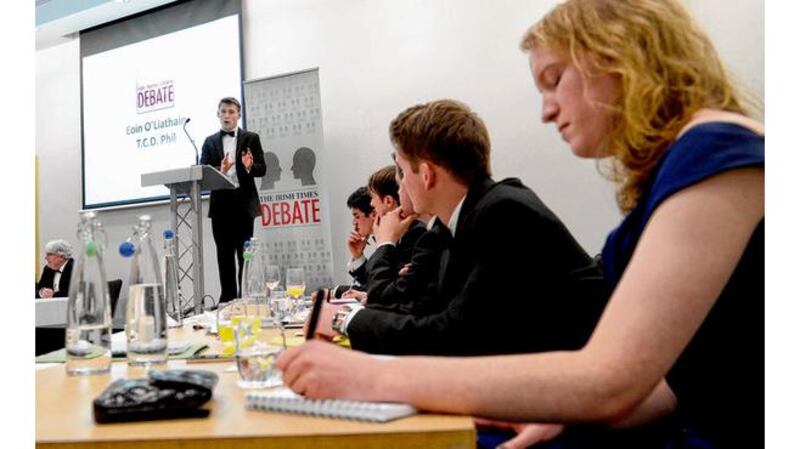
At the final of the annual Irish Times Debate in Belfast last weekend, 12 of the country’s best student debaters argued the motion that “This house would emigrate”. Here, some of the speakers summarise their arguments for and against emigration.
PROPOSING
Rob MacCarthy UCD Literary and Historical Society
For generations Irish people have pursued freedom. Freedom from tyranny, freedom from ways of life being forced upon us. We have pursued freedom from shame and freedom from guilt. We no longer wish to be apologetic for who we are or who we want to be.
Emigration is this freedom coming full circle. Emigration is the ability to make a life for yourself in spite of adversity. It is the empowerment to rule yourself and be comfortable in yourself, wherever you go. It is that connection with history you choose to embrace. To emigrate is to express this identity of freedom, independence and opportunity.
OPPOSING
Kate Brady TCD Historical Society, winner of the individual Christina Murphy memorial prize
An emigrant has left their country in the belief that they will not be returning. These people are looking for somewhere else to settle, somewhere else to try to belong. The explorer travels in the knowledge or hope of return. Because of this, the explorer, and not the emigrant, can engage with new experiences and different realities of other countries and cultures.
The explorer can see new worlds on their own terms.
The emigrant, however, the person who will not be returning home, is much more likely to constantly compare their new experiences with what they have left at home. Such emigrants cannot value such experiences for what they are, as they struggle to see past what they are not. You can’t experience something good about a country if you are continually missing your own home. That is the difference between the mindset of an emigrant and the mindset of someone who has travelled.
PROPOSING
Adam Kydd Queen’s University Belfast Literary and Scientific Society
The Irish graduate is rigorously and holistically educated, highly skilled and English-speaking – without the nasty Anglo-American habit of invading lots of places. The Irish graduate is no amateur emigrant. He is professionalised for the globalising world.
By sending young graduates to Russia, China and Brazil, Irish business will learn more about emerging markets, and foreign investors will grow to trust them as familiar faces. And if business turns sour for one Irishman in China, he’s likely to have an old friend from NUIG who’s been there before.
OPPOSING
Liam Brophy TCD Bram Stoker Club
(winner of the team Demosthenes trophy with John Engle)
Irish people are drawn to stories, and the one we like to tell ourselves is that we’re victims. A spiritual, lyrical, tragic people who have never been fully in charge of our own fate; always prey to some bigger, bullying outside agent. Emigration is one of the great themes in our national narrative and it serves as a sort of perpetual epilogue; the tragic end to most chapters of our history.
This would lead one to believe that emigration is inevitable. That is a mistake. Emigration will only remain an Irish problem as long as we create a context in which it can flourish.
What got us into the situation we’re in right now? At the most basic level, it was an attitude to political life that is immature. A mentality that regarded things such as proper regulation and genuine restraint as inconvenient obstacles to getting stuff done and taking care of people. The political system that led us into this crisis is a sort of incubator for mediocrity and corruption, a fertile ground for crises leading to emigration in a never-ending cycle.
Every time a generation emigrates the impetus for change is lost.
Emigration relieves the pressure on the Irish system, both economically and politically. The people who could be best expected to demand change are scattered to the winds. It’s a vicious cycle and to break it, our generation must remain here. We are a generation that is better educated, more progressive and possibly more let down by the Irish themselves than at any time in the past. These things should compel us to call for change, both in our attitudes and in our institutions.
It is not an inevitability that Ireland has to be prey to fate. Being forced to emigrate by the vagaries of chance and incompetence shouldn’t be what it quintessentially means to be Irish; not any more. An Ireland that has the confidence to demand a better quality of politics and politicians is one that can break the cycle of crisis and emigration. We’re at a critical juncture right now and if we can bring to bear the talents of the young, we can fulfil the actual and not just the rhetorical legacy of all those Irishmen and women who fought for the right of self-governance in the past.
PROPOSING
Brian O’Beirne TCD Philosophical Society (speaking with Eoin O’Liathain)
Emigration is a topic that occupies one of the darker corners of the Irish psyche, inextricably associated with Famine ships, fallow fields and forgotten people; with shame. But this conception belongs to a bygone era.
An era without free movement of labour, capital and industries; an era without Ryanair, Skype and Facebook. We are no longer a lonely rock in the North Atlantic, no longer economically and culturally isolated. That was traditional Ireland; and traditional Ireland is dead and gone.
Emigration, in this modern context, serves Ireland’s best interests. Our workers can exploit foreign labour markets: young graduates, trained for jobs in an economy that never materialised, can seek out opportunities abroad. There are jobs for teachers in England, skilled tradesmen in Canada, and construction workers in Australia.
Moreover, skills acquired in Ireland have never been so transferable to foreign contexts: nurses in Australia are highly sought after for the skills they have acquired here in Ireland, and, in turn, they are acquiring valuable experience which they can bring back home. And, unlike in previous cases of emigration, coming back home is a real possibility: 104,000 emigrants have returned to Ireland since 2008, a feature that was nowhere to be seen in earlier patterns of migration.
Despite how much emigration has changed, it is still seen as a dereliction of duty to some, who begrudge emigrants for leaving. A recent “Ireland Abandoners” Facebook page accused emigrants of abandoning Ireland, claiming they should stay around because the increased patronage for pubs and taxis would somehow be the saving grace of Ireland’s economy.
These fatuous remarks reflect how much anachronistic attitudes continue to dog current understandings of migration, and how inured to modern realities these attitudes are. They are not a sober and rational assessment of the individual circumstances of each emigrant, just reactionary, vacuous and vindictive bile. It is these attitudes that continue to foil our approach to the issue of emigration, damage our relationship with the diaspora, and stifle our attempts to adapt to a changed economic landscape.
The time has come to view emigration differently: as something constructive, not destructive, as an opportunity, not abandonment. It is time to put the American Wake to bed, to celebrate the pursuit of opportunity, to welcome returning emigrants home with open arms. Their prosperity and happiness should be an end in and of itself and conversely, in this modern age, emigrants can contribute to Ireland just as much as those at home.
But they can only do so if they recognise Ireland as their home, and we recognise them as our people.
OPPOSING
Rián Derrig TCD Historical Society
As immigrants in other countries we are invariably a people of unparalleled energy and ingenuity, good spirits and friendliness, intelligence and often an uncanny sixth sense for interpersonal relationships. I can only imagine what we could do if we allowed ourselves to think like that, to be like that at home. It’s a bizarre thing; people complain that much of Irish society is narrow-minded, parochial, localistic, but yet abroad we epitomise blue-sky thinkers, trailblazers and entrepreneurs.
We think of ourselves as the oppressed race. But ask yourselves, who is oppressing us now, if not ourselves?
PROPOSING
Austin Conlon UCD Literary and Historical Society
Emigration allows all your experiences to be different and richer. From the foods you eat, the people you befriend and fall in love with, the music you dance to, the languages you hear, the literature and history you read, everything is different. But to truly understand another place, you must live there, work there, love there, pay your taxes there.
This experience gives you a unique perspective on humanity and on Ireland itself. If you love Ireland, you will understand why you love it once you have somewhere else to compare it to. It’s no coincidence that some of Ireland’s greatest minds, such as Joyce and Beckett, lived abroad for much of their lives.
Those who argued in favour of staying in Ireland won the debate


