
On Tuesday a report by Martin McAleese may finally help to write the story of State involvement in the Magdalen institutions, a shameful chapter in Ireland’s history
So much of the story about the Magdalen laundries centres on names; on identities lost, abandoned or forgotten. Thousands of girls and young women went through their doors during two centuries. Each had her Christian name changed by the nuns, her surname unused.
On her marriage to an English soldier after she had fled Ireland, Margaret McCarthy changed her surname to that of her husband, Frederick Permaul. By then she had already changed her Christian name to Marina.
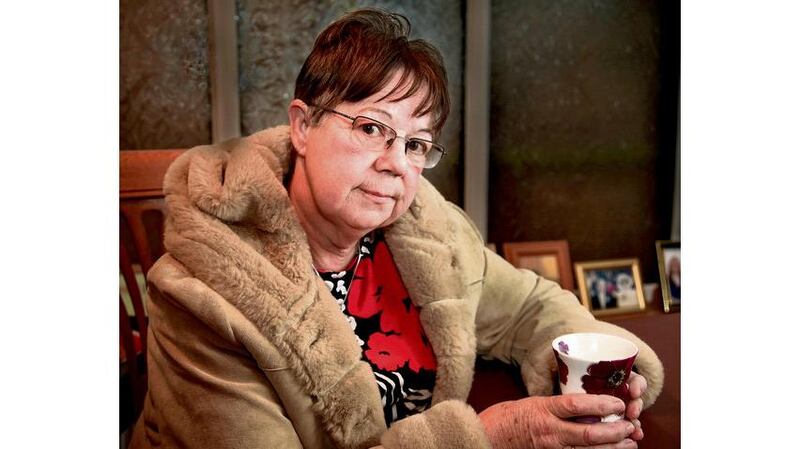
“When I came over I wanted to wash Ireland clean away. It was like taking off dirty linen,” says the drily humorous 69-year-old, in the sitting room of her home in Cricklewood, north London, this week.
More than 50 years have passed, but the feelings of fear, entrapment and “that all hope was lost” are as vivid for Permaul as they were on the day she ended up in the Magdalen laundry run by the Sisters of Mercy at 47 Forster Street in Galway, near the city’s railway station.
Born in Ennis, Co Clare, to Martin and Margaret McCarthy, she, like her five siblings, had her life overturned after the death of her mother from TB and her father from “bronchial problems”.
Sent to live with an uncle, the six children soon ran wild. “We were found wandering the streets, not going to school. The gardaí took matters to court. Our uncle said he couldn’t keep us. The boys were taken to St Joseph’s in Salthill. My sister and I went to St Anne’s at Lenaboy in Galway.”
Permaul lived there, not unhappily, from the age of six until she was 13. “One Sunday morning I was going up to the church for Mass. After 12 o’clock Mass the nun asked me to change the flowers on the altar. As I changed them, Sr Bertmans came down from the side door. She told me to leave what I was doing. I got a strange feeling, a feeling of entrapment; I felt something was wrong. I went to run out.
“Another nun came. The nuns grabbed me, and they had a car waiting outside the chapel. The driver drove off. I was shouting. You don’t expect nuns to do this. I didn’t know what was happening. ‘Where are you taking me?’ I said. I started to cry,” says Permaul, her voice trembling.
They arrived at a side door to the laundrey. “I always remember the green door. I knew I was in a Magdalen. It was almost like a mental hospital, where only bad people went. It was a taboo subject. We grew up knowing this,” she says.
Like others, Permaul speaks of the hunger for escape. “I prayed every night to St Anthony, prayed that I would get out. I knew I was in there for life, because there was no one to get me out. A girl died. I knew I had to get out.”
Soon she began to plan for freedom, stealing a cardigan from a laundry bag. But before she could take her plans further, she was spotted by a nun from Lenaboy who had come to Forster Street for a Christmas choir. “A nun told me to clear out my locker. Miss Broderick, a lay teacher, brought me back. Nobody told me anything. You didn’t dare ask a question. I went back to Lenaboy. Nothing was said; that was the strange bit.”
The seven months inside the Magdalen have left the deepest of scars.
Thousands made the same journey. Some were unmarried mothers, deemed promiscuous by the authorities. More, perhaps most, were the daughters of such women, or “considered a burden” by their families or the State, had been sexually abused or had grown up in care.
Tuesday’s report
Next Tuesday’s report by Senator Martin McAleese “should, for the first time, enable us to speak with some authority about the numbers of women who entered these institutions after 1900”, says Dr James Smith of Boston College, who has spent years researching the Magdalens.
“According to the 1911 census, there were 1,094 women recorded at the 10 Magdalen asylums that would continue to operate after Irish independence,” says Maeve O’Rourke, who prepared a submission on the Magdalens for the United Nations Commission on Torture in 2011.
“In 1956, the Irish Catholic Directory and Almanac reported a capacity for 945 women at these same institutions,” says O’Rourke, who is a trainee barrister in London. She has spent many hours interviewing former inmates who now live in London.
The Magdalens were excluded from the Residential Institutions Redress Board. The State argued that it had never inspected or regulated the laundries and therefore was not responsible for them.
Mary Currington experienced the care of the Good Shepherds nuns in Co Wexford. Born to Sarah O’Neill, an unmarried woman, she lived in the county home in Enniscorthy, Co Wexford, until she was three and then, securely, with her aunt Anne in Monageer until she was five.
At that point she was made a ward of court and sent to the children’s home run by the Good Shepherds in New Ross. At the age of 16 she was sent to work for a sister of one of the nuns at Killavullen, in north Co Cork, where she served for nine months as a domestic.
Unhappy, she wrote seeking permission to go back to New Ross, which was “‘the only base I had”, says Currington, who now lives in Dunstable, in Bedfordshire. She returned in time for the visit of John F Kennedy in 1963 – “His stooped back, God help him.” Shortly afterwards, she met a friend with a child on the street. “I asked her where her husband was. She said, ‘I am not married.’ I told my friend that she was telling lies.
“Before I went to bed I met with one of the nuns. I told her that the girl was pretending that the baby was hers. I remember her saying, ‘We were wrong to leave you out of the school without telling you the facts of life.’ I said, ‘The facts of life? What are you talking about?’ ”
Two weeks later, Currington found herself standing in the parlour of the Good Shepherd convent at Sunday’s Well in Cork: “Four nuns stood around me, saying, ‘What shall we call her?’ I kept saying, ‘I’m Mary.’
“They weren’t listening. ‘Oh, we’ll call her Geraldine,’ they said. I wasn’t understanding at all; why are they changing my name? I was so confused,” she says, sitting in the home of a friend, her cup of tea growing cold on a table beside her.
The indignities began even before she saw the laundry. “My hair was waist length and it was chopped up to my ears. My clothes were taken off me and I was given rags, and I mean they were rags.” Soon she ran into trouble after she and a friend enjoyed themselves pushing each other in trolleys late one Friday evening, after finally finishing mountains of laundry sent by the hotels, army barracks and private homes of Cork city.
“Sr Mount Carmel was horrified. We were sent to the office, and she said that we had left the whole place down,” says Currington. She was sent to the sewing room against her wishes, but she developed a lifetime love of the craft.
“I knocked out beautiful work. We made all the vestments for the altar, all the altar linen, all the altar boys’ gear, the banners for the processions,” she says.
Four years on, when Currington was 22, she planned her escape, along with another woman, who was two years older. As in Permaul’s case, the first requirement was clothing.
“I told my friend to get a couple of dresses. We daren’t escape in our own clothes, because they would know straight away where we were from, and from our haircuts,” she says.
“The side door to the sewing room was left open, and there was a little alleyway, tree-lined. Every step we took going out of those convent grounds, I was looking back to see if anyone was watching us.” It was July 1967, “or perhaps August”.
Soon they were down in Cork city centre, outside Winthrop Arcade. Her friend went in to get money from the young men and boys playing the penny machines. “We had no money. We didn’t know what money was.”
While waiting, she was approached by a garda, “a big, tall guy. I was very shy. I gave a wrong name. He asked if I was on my own.” Minutes later, he had found her friend. “He told us we were going back to the place that ‘you escaped from’. I could not believe it. The nuns alerted the Garda any time people ran away.”
She spent two more years in Sunday’s Well. Freedom came in the form of a Vincentian priest, Fr Tom Bennett. “He didn’t like the nuns. He hated them for locking us up. He used to campaign for me to be left out. He’d barge into her office and leave the door open, so that I could hear. Sr Mount Carmel said, ‘Geraldine isn’t mature enough.’ ”
Currington’s release came quickly, without notice. “I got up at 6am. I had my towel, toothpaste and flannel. An auxiliary, Bernadette . . . told me to come and fix her zip. I laid my towel on my bed. Once the door closed, she told me I was leaving. I had such mixed emotions. What about all the people I had known for six whole years? Suddenly I was plucked out, put on a train and sent to Drogheda.”
She spent seven months working as a ward maid at St John of God at Courtney Hill in Newry. “I decided I would be free of the nuns if I went to England. I came to England on July 7th, 1969. My sister was waiting for me in Luton.”
Survivors’ meetings
For more than a decade, Sally Mulready and Phyllis Murphy, who were both reared in institutions but were not Magdalens, have worked with institutional survivors in Britain. More than 30 former Magdalens come to their London meetings.
The Magdalens they found form only a fraction of those living in Britain. The Irish Government ran advertisements in the Irish Post and the Irish World when it was promoting the Residential Institutions Redress Board.
“I said they should advertise in the breaks in Coronation Street. Some of our people won’t pay £1 for an Irish newspaper that talks only about all the happy things that are going on,” says Murphy.
Funding is tight for the London Irish Women’s Survivors Group. Money comes from the Ireland Fund of Great Britain and the St Stephen’s Green Trust, but nothing comes from the Irish State. “We had been running meetings on a monthly basis, but we had to cut back.”
Britain brought freedom, if not happiness, for many, says Murphy. “So many are too ashamed to come out. They would be ashamed for their families to know, especially if they are married to Irishmen. They would feel, What kind of woman did I marry? It didn’t really matter with British men, because they didn’t look down on you, myself included. I always found Irishmen reacted [in a way that implied],‘ I don’t want to know you.’ The look on their faces, as if you were a piece of dirt.”
Despite their difficulties, the women found are the lucky ones, says Maeve O’Rourke. “Sometimes I met women who reacted with surprise if they heard of others. ‘You mean there are others here?’ they’d say. They genuinely felt they were the only ones who had escaped.
“Their names were changed, they left without warning, or escaped. People lost their best friends, often their only friends. There is still a sense of longing for the people they had in there. And sometimes there is guilt for the people that they left behind.”
With days to go until McAleese’s report, the former Magdalen women wait expectantly. An apology is important to some, less so to others; all demand payment for years of unpaid labour, as well as pensions “even though the nuns never paid our stamps”.
“We’ll see what it brings. If it doesn’t, we’ll have to consider something else. If they come up with the right thing then it will end,” says a former inmate, who identifies herself by her Magdalen name of Brenda because she does not want to embarrass the family of her Irish husband.
But there is one demand: no repetition of the Residential Institutions Redress Board, says Mulready. “They don’t want to see lawyers being the beneficiaries. They feel that they have told their story over and over, and the nuns have records.
“They feel that the history is out there. I believe that a lot of them would not be able to withstand a rigorous system. It is up to the State to come up with a service that protects their rights. What they don’t have is time,” says Mulready.
After operating for 200 years, the last of the Magdalens closed in 1996. “A lot of people did not shout. A lot of people knew. They say that they didn’t want to get involved; they just thought they were ‘bad girls’.
“Young people should read the report and care about what happened to a whole generation of Irish women. Irish snobbery brought about a whole lot of discrimination, particularly against poor people. It was so endemic that nobody cared.”
Magdalen inquiry What is Tuesday’s report?
The report on the Magdalen laundries is expected to be published on Tuesday. It will be presented to the Cabinet that morning.
It has been prepared by a committee of officials from five Government departments, chaired by Senator Martin McAleese, assisted by another official from the Department of Foreign Affairs.
The laundries, where an estimated 30,000 single mothers and other women were detained between 1922 and 1996, were operated by four religious congregations. Most of the women have since died. The last one, at Seán MacDermott Street, in Dublin, closed in 1996.
On June 14th, 2011, Minister for Justice Alan Shatter announced the Government was to set up the committee to investigate the State’s role in the Magdalen laundries. The previous week the four religious congregations concerned agreed to co-operate with any such inquiry.
Shatter’s announcement followed a lengthy campaign by the Justice for Magdalenes group and a report from the United Nations Committee Against Torture.
The 10 laundries were operated by the Sisters of Mercy (Galway and Dún Laoghaire, Co Dublin), the Sisters of Our Lady of Charity (Drumcondra and Seán MacDermott Street, Dublin), the Sisters of Charity (Cork and Donnybrook, Dublin 4) and the Good Shepherd Sisters (Limerick, Cork, Waterford and New Ross).
- PATSY McGARRY


