HISTORY:Though it comes up with few definitive answers, a superb and witty book that examines our origins as a people shows how important it is that we ask the right questions
The Origins of the Irish, By JP Mallory, Thames & Hudson, 322pp, £19.95
Prof Jim Mallory has written a book on the origin of the Irish, but he tells us that the subject “is not a single question and the reader should not expect a single answer”.
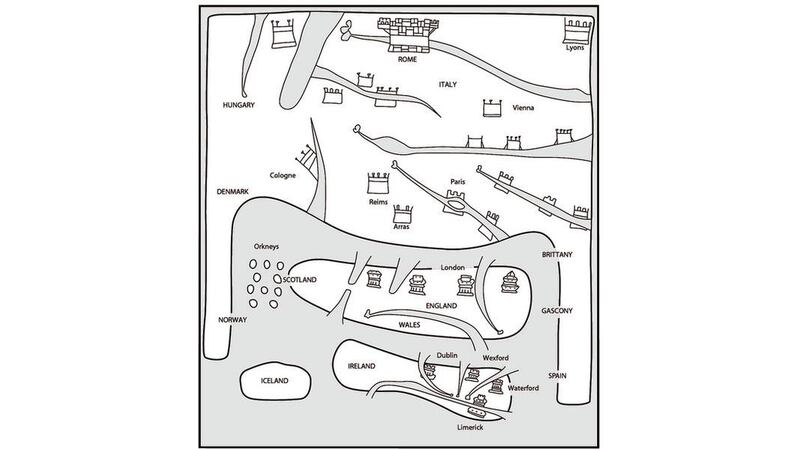
This book has been in gestation since Mallory began graduate studies at the University of California, Los Angeles in 1967. Along the way he developed a battery of skills that make him, perhaps uniquely, qualified to write a book that evaluates the contributions of archaeology, genetics, linguistics, geology and history in developing a plausible story of the origins of the people of Ireland at the beginning of the historic period, say in the fifth century AD.
Mallory takes us on a journey from the big bang, through plate tectonics, climate change and millennia of human settlement to reach his target Irishman, the half-British Niall Noígiallach (“of the nine hostages”), who “straddles the boundary between Irish mythology and Irish history”.
When did the Irish begin to think of themselves as such? Did the idea emerge in prehistory? Hardly, because of the fractured political structure we can probably deduce from the archaeology of the period – but without a written record, how can we tell? However, the appearance of a uniquely native form of ritual monument in the final BC centuries at Tara, Knockaulin, Emain Macha and Cruachan suggests some sort of shared vision of the island and the cosmos.
Munster, with its later centre at Cashel, does not fully share in that vision – a fact that is reinforced by the rarity of objects of classic “Celtic” character during its long Iron Age from about 600 BC.
A theory of Irish origins was constructed by the learned classes of the early medieval period, who, like other Europeans of the time, fabricated a derivation from biblical and other ancient histories. In their version the Irish (Scotti) descended from (who else?) the ancient Scythians. They arrived here after a series of implausible wanderings.
It never occurred to the scholars to canvass the Celts of classical authors as possible ancestors. There is, for example, no hint of a connection with the (Celtic-speaking) Welsh, a link recognised only in early modern times. It is very likely that the idea of the Irish as a unitary people gained strength from the use of an early form of the Irish language throughout the island at least by the middle of the first millennium AD, and also by the conflicts of the Viking age.
Genetic studies seem to hold out the promise of sorting out the origins of the Irish, but Mallory is sceptical about their reported success to date. (He points to Hungary, where the modern population’s genetic profile does not reflect the many recorded invasions, with language changes, of historic times.) However, he is not in the least dismissive of its potential to make a significant contribution when analysis of the genetic signature of the modern population is controlled by a programme of study of the DNA of the ancient inhabitants and where telling genetic mutations can confidently be anchored to reliable dates.
Social and religious change
Humans came to Ireland about 9,000 years ago, most likely from Britain. The population was small. It is difficult to assess what contribution these earliest “Irelanders” (as Mallory calls all early inhabitants of undetermined origin) made to the Irish gene pool. There appear to be two major trends in the formation of the early population of western Europe. First, there was settlement by modern humans who had survived the last Ice Age in refuges (in the Iberian peninsula and Italy, among others) and who moved northwards as climate improved. A second major stream of population originated in southwest Asia and is associated with the spread of agriculture in the Neolithic period.
By about 3800 BC, farming had reached Ireland, primarily, but not perhaps solely, as a result of migration from Britain. Mallory has no doubt that a significant influx of people accounted for the radical change in subsistence (from hunting and gathering to farming) and in religious belief and social organisation in this period. Native hunter-gatherers in mainland Europe adopted the Neolithic way of life, but the evidence for this is slim in Ireland.
If the original inhabitants had mingled with the incoming Neolithic settlers, the evidence for this may be masked by the similar genetic inheritance of the newcomers through the mixture of the older and newer population streams before their arrival in Ireland.
Are there any indications of immigration by which, in later times, new people may have arrived on the island? At the beginning of the metal age, around 2500 BC, the appearance of metallurgy itself and special “Beaker” pottery may mark some augmentation of the population.
Things are a little less clear in the mature Bronze Age, from about 2200 BC, but constant contact with Britain opens the possibility of a trickle of settlers in both directions, which may be suggested by variants of burial ritual and fashions in funerary pottery.
From the Middle Bronze Age (circa 1600-1200 BC) there is strong evidence of social and religious change, with the emergence of a warrior elite signalled by the ritual deposit of weapons and ornaments and a gradual tapering off of earlier funerary traditions. Agriculture expanded and there were long-distance contacts with mainland Europe. The Late Bronze Age (circa 1200 to 600 BC) was also a period of dynamic change.
After circa 1200 BC, we see new monuments – hilltop fortifications – which may indicate a new system of organisation of the population and of the landscape. From circa 1000 BC, conspicuous consumption in the form of increased votive deposits of metalwork appeared.
Mallory is sceptical of the notion that there was an incursion, however small-scale, towards the end of the period.
In the Iron Age (circa 600 BC-AD circa 400), objects decorated in the Celtic “La Tène” style began to appear around 300 BC. Mallory notes how difficult it is to track the early Iron Age in Ireland; although ironworking is present from as early as circa 600 BC, settlement is harder to find, and he is unconvinced that any military invasion in the period accounts for the arrival of a Celtic-speaking people, although some infiltration by elite groups is possible.
It has been almost an article of faith that “the Celts” invaded Ireland in the Iron Age, but Mallory’s best bet on the date when a Celtic language was first spoken in Ireland is the period around 1000 BC. He firmly rules out any earlier date as very unlikely, on linguistic grounds.
Mallory offers few definitive answers to most questions but instead engages in a superb and witty ground-clearing exercise and charts ways to take the inquiry forward. At the end of each chapter is a list of conclusions – the conscientious teacher summing up his seminars.
Above all, his book is an exercise in showing the importance of asking the questions that different kinds of evidence can answer, and, as a tour d’horizon, it is unmatched.