N ot since Fidel Castro was in his 1960s revolutionary pomp has a Latin America n leader captured the world's attention – and divided its opinions – like Hugo Rafael Chávez Frías.
His death, earlier this month, made headlines around the globe and intensified debate about the merit of his self-styled Bolivarian Revolution.
To supporters, Venezuela 's president was a revolutionary leader unafraid to stand up to the yanqui imperialists in his attempt to supplant the cruel capitalism of our globalised era with his enlightened 21st-century socialism. To enemies he represented a throwback to the military caudillos of his region's dark past, a dictator drunk on his country's oil wealth.
Even in death this argument looks set to remain fierce, both within and beyond Venezuela. It is an ideological battle in which too often the loudest voices belong to the shrillest partisans of both left and right.
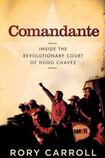
This is all the more reason to be grateful for the arrival of Comandante , a deeply thoughtful book-length report on Venezuela under Chávez by Rory Carroll, the Guardian newspaper's Caracas bureau chief from 2006 to 2012. Long-form reporting is enjoying something of a golden age in Latin America, and with this gripping narrative, Carroll, a Dubliner, has produced an English-language account to accompany the best of those by the region's writers.
A deconstruction of the Chávez phenomenon, it relentlessly adds detail to telling detail that Carroll collected on his travels across Venezuela and in interviews with people who have spent time in the revolution’s inner circle to build up what is by the end a devastating indictment of the record of the president and his Bolivarian acolytes.
True believers will be infuriated if they get that far. But for those fascinated by Chávez yet able to follow him only from a distance, this book, by turns personal, wry and wise, is required reading.
The portrait that emerges is of a leader who in truth was no leftist, just another Latin caudillo, the ideological trappings of 21st-century socialism flimsy window dressing for his populism and subordinate to his own will to power. Carroll’s Chávez is widely read but no profound thinker. This perhaps explains the ease with which Fidel Castro, an altogether weightier strategist, was able to dominate his younger colleague to the immense financial gain of his impoverished island.
Chávez pronounced himself a socialist only once he turned over large parts of his government to Cuban advisers, after the failed 2002 coup against him.
Both his public megalomania and his private cynicism, which join in his voracious appetite for power, are exposed for all to see. But this is no hatchet job. Carroll reveals that he too wanted the revolution to succeed, not necessarily the revolution of El Comandante but the one being attempted by 15 dirt-poor farm labourers he visits as they try to turn a piece of swamp into a new agricultural co-operative.
At night, as they sit around a campfire singing love songs, their leader confidently tells Carroll that they are part of something bigger, a movement to fix up the country. “If wanting them to succeed was taking sides, so be it,” he writes.
But almost everywhere he finds evidence of a failing revolution. His travels across Venezuela reveal that incompetence piled on top of mismanagement wrecked domestic agriculture and ruined national industry. The result is a country more dependent on imports paid for with oil exports, intensifying the dynamic that Chávez had promised to lessen when he came to power.
This dependence is all the more worrying as he starved the state oil company of the investment it needed to maintain production, which has been in decline for a decade. Instead he ordered the firm to spend its profits on the sort of social spending that provides a more immediate electoral return. It is hard to argue against more money for health and education, but it is the economic equivalent of slowly strangling the goose that lays the golden egg.
Despite the price of a barrel rising from just $8 when he took power to more than $100 today, exports of the country's black gold are no longer enough to meet his spendthrift government's needs. And so this vocal critic of US imperialism has mortgaged the country's future to China, running up huge debts with Beijing at a time when other big oil exporters have been stashing away hundreds of billions for future rainy days.
This public indebtedness is taking place against a backdrop of official corruption on an Olympian scale that is creating some of Latin America's largest illicit fortunes. Carroll reports one eye-watering estimate of $17 billion vanishing from the state into overseas accounts each year . Chávez's socialism has produced a new elite of crooked generals, dodgy bankers and nouveau-riche "Boligarchs", who were all allowed to grow wealthy so long as they did the president's bidding.
Many outsiders worried about Chávez’s authoritarianism. But Carroll declares that he was far from being a dictator and that the graver danger was the moral swamp into which the country sank during his presidency. All that kept the show on the road was the global thirst for oil. With the world’s biggest reserves, there could be a lot more of Venezuela’s future to mortgage off before creditors pull the plug. This matters.
In Latin America populism tends to be a successful political strategy until the cash runs out, as the splurge with borrowed cash before last year’s presidential election indicates.
But, even so, the dream had died, writes Carroll, replaced by an empty revolution. “No paradise, no hell, just limbo, a bleak, misty in-between where ambition and delusion played out its ancient story.”
The book terminates with Chávez re-elected for a third six-year term but battling for his life against cancer. Since then he has died, and what happens next to his revolution is obviously beyond the book’s scope.
But Carroll hints that one of Chávez's great contributions – forcing Venezuela to acknowledge its social debt with its own poor – means that, despite the disasters catalogued here, his movement could outlive him. "By compelling a grossly unequal society to acknowledge its invisible underclass Chávez wove himself so deeply into the nation's fabric the poorest, most wretched corners of Venezuela would surely continue to adore mi comandante long after he was buried. What politician does not dream of such feats?"
Chavismo after Chávez? It is possible. After all, in Argentina Peronism has remained the country's largest political force, decades after the death of its founder, Juan Domingo Perón. But even if it does not, this book will still be read as a record of the dangers false messiahs hold for the damaged societies they seek to save.
Tom Hennigan is the South America correspondent for The Irish Times and is based in São Paulo, Brazil.