

Covid lockdowns are best erased from our memories, but who could forget Llandudno’s renegade Kashmiri goats?
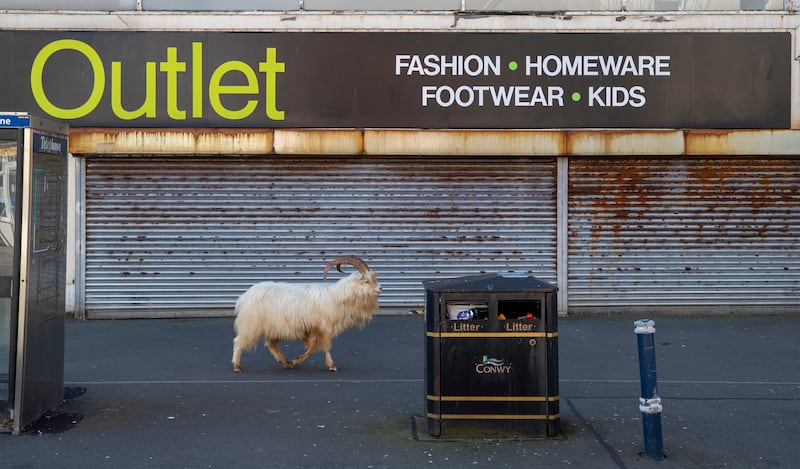
They went viral worldwide in March 2020 during Britain’s first lockdown when the wild herd on the Great Orme descended from the headland, taking over the deserted streets of the Welsh seaside town below.
As the world reeled from the onset of Covid, it seemed like a dystopian animal uprising might be under way. People also needed a laugh. The goats gobbled up all of Llandudno’s flowers and wouldn’t do social distancing. Rebels. I had to meet them.
My chance came last weekend while in town for a Plaid Cymru political conference.
READ MORE


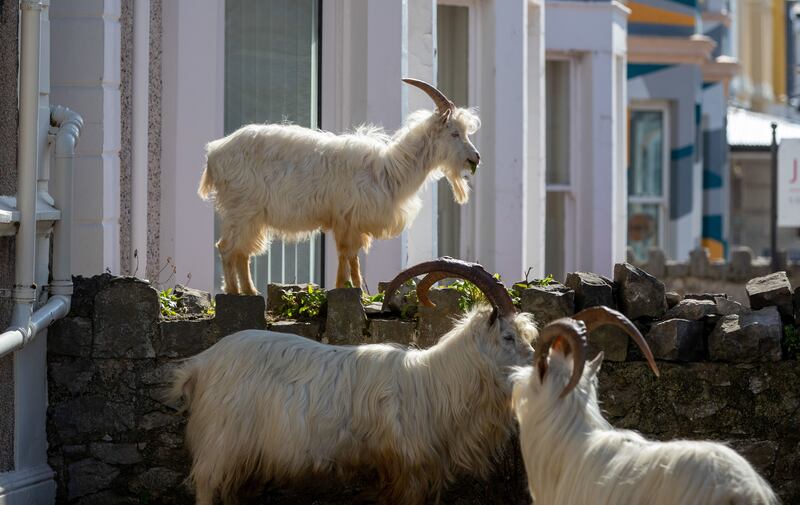
Llandudno’s wild Kashmiri goats are descended from a herd kept by the British queen Victoria, who got them as a gift from the Persian Shah. He thought she might like her own cashmere – the goats’ shaggy coats are prized.
Lord Mostyn, a Welsh nobleman, was granted a few from the royal herd. They ate all his flowers too, so he released them at the end of the 1800s on to the limestone headland of Great Orme, the great big slab of grey overlooking Llandudno’s pier.
The distinctive white goats with their shaggy coats, beards and dramatically curved horns have roamed the headland ever since, with the herd now up to about 180. I once read that the Welsh authorities used contraception to keep the numbers down. For clarity, they used injections.
As soon as I could wriggle free of the Plaid conference on Friday, I headed for the Great Orme in the little hire car I had driven over from other engagements in England’s northwest. It was spitting rain and windy. There was no way I would roam the hills. I’d have to find my shaggy rebel heroes from the road instead.
I drove past Llandudno’s pier – voted “Pier of the Year 2025” – and up the hill to the spectacular road that hugs the underside of the crags. Soon I hit a fork in the road. Which way? Up is surely a good bet when looking for goats.
Soon I stumbled upon a wonderfully picturesque and, in the inclement weather, eerie old cemetery. Its gnarly trees had been bent into unnatural shapes by decades of wind. It was the cemetery of St Tudno, a sixth century hermit monk who founded the town. I found ancient graves and lots of sheep. No goats.
It was getting dark and there was nobody else stupid enough to be still out on Great Orme, but I kept going. Always up. I passed the deserted cable car station, the 4,000-year-old copper mines and an old tramway before, eventually, I reached the summit.
The car rocked in the stiff breeze. I parked overlooking the village of Dwygyfylchi across an inlet below. Ten consonants before a lone vowel – how very Welsh, I thought. I watched seabirds being buffeted in the big wind. Boats skipped across the water. Still I saw no goats. As the light declined, I had to abandon my search.
Next morning I was speaking to Liz Saville-Roberts, who leads Plaid Cymru’s group of MPs in Westminster. We were on the promenade, a mile from the headland. She claimed she could see goats from there: “Look at the white blobs moving on the cliff.”
God bless her eyesight. I raced up the promenade. Sure enough, as I reached the pier, people were taking pictures of two goats precariously perched a hundred metres away on a cliff edge above the Elm Tree hotel – the goats still regularly pop down to town.
I wanted to get closer, but first I had to work. As I made my way back to the Plaid conference, I was assailed over loudspeaker on the promenade by Dave, a busking ventriloquist from Chester, and his sarcastic puppet, Archie.
For some reason that I now cannot fathom, I gave Dave £3. Archie sang me a witless song over the loudspeaker. A crowd gathered, so I discreetly backed away. As I left, a homeless man in a hoodie said to me, deadpan: “I bet that cheered you up.”
I didn’t know why it was now so important to me, but I had to find those goats.
It was a glorious sunny day. I headed back up the Great Orme in the afternoon. I parked beneath a cliff. I climbed halfway up but abandoned it when it got too steep: I was wearing a pair of centrist-Dad black Vans and a blazer, not hiking gear. I had goat fever.
I found another route up a shoulder to access the open headlands. Eventually, I spotted a lone Kashmiri goat, a female identifiable by her shorter, less curved horns. Her beard, however, was worthy of ZZ Top.
It was rutting season, so I followed her from a distance, lest a bigger-horned suitor was nearby and feeling frisky. She led me to the other side of the headland, looking out towards the Isle of Man. Dozens of the goats were fanned out, lying on the hill in the sun.
I watched them for half an hour as they stared out at the blue waters below. A few munched from the heather as the grass all around them quivered in the slight breeze.
One goat, a big male with looping horns, kept bullying the others, butting them for no apparent reason. Finally, one of the smaller goats butted him back.
Good on these rugged Kashmiri goats of Wales. They never do what they’re told.