
It was a century in the making, but Welsh nationalist party Plaid Cymru’s ascension this year to lead national government for the first time still seems to be in transition.
Governing party conferences always attract protests. Yet at Plaid’s conference last weekend in the north Wales seaside town of Llandudno – its first gathering since it swept Labour from power in May – it wasn’t always clear who the protesters were, and who they were protesting against.
Llandudno is a pleasant old Victorian resort town, more attractive than others of its ilk. The town’s genteel air was reflected in the halfhearted protests that showed up as Plaid members gathered at Venue Cymru on the promenade.
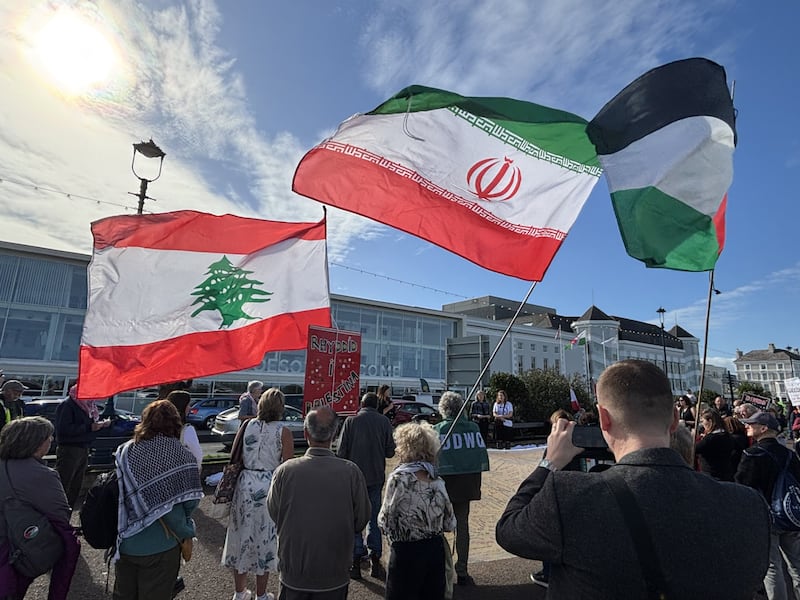
A seemingly ridiculously over-policed pro-Palestine protest ambled along the seafront in Saturday’s glorious sunshine, halting outside the venue for a rally. Plaid is already one of the most pro-Palestine parties on the island of Britain.
READ MORE


Instead of lambasting the government, as protesters tend to do, the first speaker spoke about how “refreshing” it was to have a party in power that shared their views – a few of the crowd actually wore Plaid conference passes.
The second rally speaker was one of the Welsh government’s most senior figures, deputy first minister Sioned Williams. Amid a sea of fluttering Palestine flags, Welsh dragons, Lebanese flags and even a few Iranian ones, the “protest” crowd clapped Williams as she criticised Israel.
Another apparent protester in a green Morris Minor pickup drove up and down the promenade outside the venue, beeping his horn. Attached to his vintage van were the national flags of Wales, Scotland, England and a British Union Jack.
Nobody, including bemused security, could figure out what he was saying, but it was widely assumed he must be pro-union. If he was, he was very friendly about it, waving at Plaid delegates each time he zoomed past.
The only real animus towards Plaid came from striking Unite union health workers. They accused party leader and new Welsh first minister Rhun ap Iorwerth of backtracking on a promise to support them. “Plaid lied” said their alliterative t-shirts.
Beyond that, it was plain sailing for ap Iorwerth, a former BBC political journalist. His conference speech was well received, although with less of the visible giddiness that greeted his speech a year ago when it was becoming obvious Plaid might win.
Ap Iorwerth complained after May’s Senedd elections that he couldn’t even secure a meeting with then UK prime minister Keir Starmer. Will new UK leader Andy Burnham be any better for Wales?
“Yes, I think so,” ap Iorwerth told The Irish Times. He says Burnham assured him in a meeting he was open to the idea of devolving policing and justice powers to Wales, a key Plaid demand, and would look at other issues.
Ap Iorwerth thinks Burnham “instinctively believes” in more devolution for Wales: “But he is surrounded by people in the parliamentary Labour Party who have shown in recent years they are ideologically opposed.”
In Cardiff, the new Welsh government’s first big task is to pass a budget – it is five seats short of a majority.
Many of the rump of Welsh Labour that survived in May are said to be followers of old leader Vaughan Gething, rather than another former Welsh Labour leader, Mark Drakeford. “Drakefordites” are thought by Plaid delegates to be bigger believers in Welsh power, while “Gethingites,” it is claimed, look more towards UK Labour for leadership.
Plaid previously helped minority Welsh Labour governments pass budgets, but so far, it is unrequited. The Plaid government has already lost one supplementary budget vote after Labour refused support. Ap Iorwerth is seeking support for a draft budget vote in six weeks. If Plaid cannot pass a budget, it will struggle to govern.
One of Burnham’s big recent announcements was a plan for a national social care service for the elderly. Speaking on the margins of the Plaid conference, Delyth Jewell, the Welsh government minister with responsibility for social care, said she had already written to Burnham’s government about the plans.
“It was in our manifesto already, so England is just catching up with us in Wales. But I welcome the fact that the UK prime minister has brought this to the top of the agenda,” she said. “Burnham’s sincerity on this issue really does shine through.”
Liz Saville-Roberts, leader of Plaid’s four-strong group of MPs in Westminster, also said the ascension of Burnham made her more “optimistic” for co-operation with Wales.
“He is more prepared to have conversations. Starmer was just: ‘close it all down.’ But while I may like Burnham, he is not my friend,” she said.
A recent poll suggested that if Burnham called an early election, Plaid could win up to 15 Westminster seats in a hung parliament. That could give it the balance of power. She was “cautious” about the possibility, but that is a card Saville-Roberts said Plaid should be “pragmatic” about playing.
Her party leader agreed. Would Plaid prop up a Burnham government if it meant winning more powers for Wales?
“If we are in the position of more influence in Westminster, to push forward on empowering the people of Wales ... absolutely that is what we are there to do,” said ap Iorwerth. Maybe Plaid’s pivot to power isn’t such a big transition after all.
[ Andy Burnham raises prospect of UK rejoining European Union after next electionOpens in new window ]