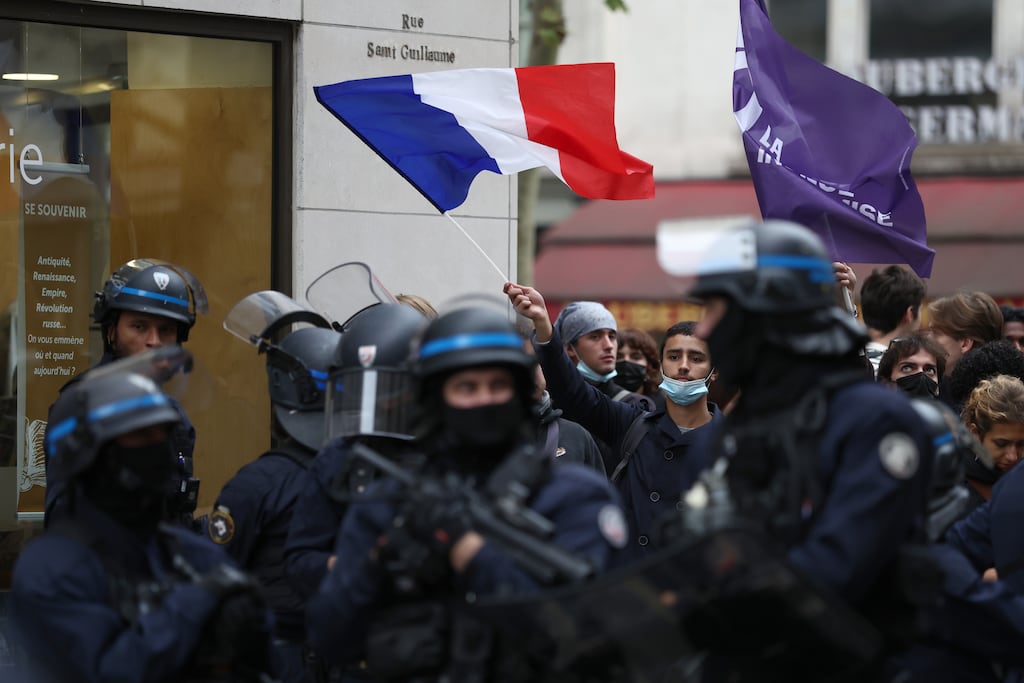
Everyone in France was expecting protests, which are practically a seasonal tradition alongside autumn budget talks.
People were braced for a particularly challenging protest season too, given the ominous combination of a looming presidential election, soaring energy prices, and a government simultaneously facing spending demands from the public and the scrutiny of markets concerned about French debt.
But no one foresaw a revolt among teenagers, starting with one high school in a Paris suburb on September 17th before spreading across the capital and the country.
Governments are well versed in dealing with protests by unions. There are leadership structures, representatives to call, and a transactional aspect, with a shared understanding of what form a win could take.
READ MORE



But a grassroots wildcat protest movement by high schoolers is very different. Who are the leaders? What are their demands? Can the movement be directed or contained?

Casting around for student representatives to question, some journalists have focused in on an impressively articulate and telegenic student of the well-regarded lycée Jacques-Decour called Elwan, whose discourses from the barricades have repeatedly gone viral on social media.
Elwan brushed away questions as he marched this week, urging journalists to look for answers in the more deprived suburbs of Paris rather than among the comfortable.
“Go speak to the people in the banlieue, who need your support and need to be heard by the media,” he said. “They’re the ones with things to say.”
The protesters’ school-related complaints are quite concrete: no more gaps in teaching because substitute teachers can’t be found; improvements to school buildings that struggle with extremes of heat and cold; days that don’t run from 8am to 6pm.
They want a broader reorientation of attitudes around students’ needs, rather than treating pupils as silent recipients of choices made from above.

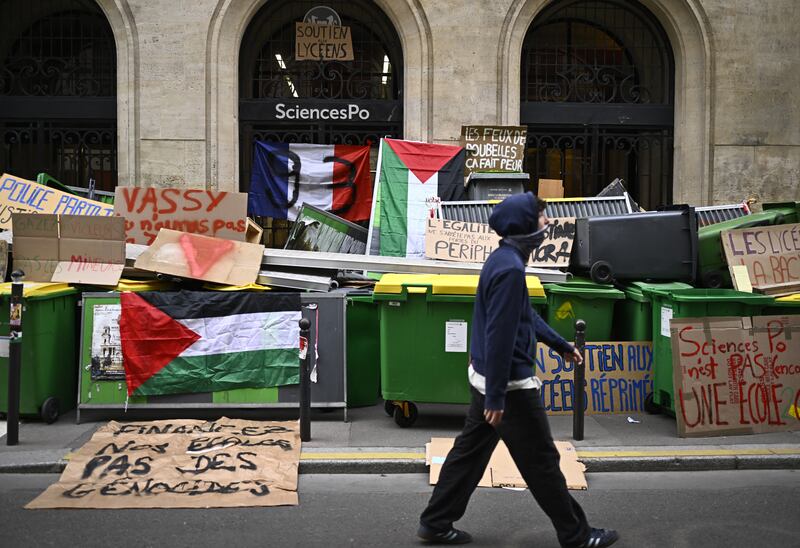
But protesters are also expressing far larger dissatisfactions. Many Palestinian flags and keffiyehs could be seen among the protest crowds. There is anger at “those in charge” for not preventing the destruction of Gaza.
Students also express existential questions: what kind of job can they expect to get in an age of artificial intelligence?
Concern about the climate crisis factors in too. What future can they look forward to?
It could all be summed up as a sense of being failed by older generations, which is being expressed in a traditionally French way.
How can the government meet such wide-ranging concerns?
So far, the response of the government has been to set up an online platform to receive students’ complaints and to bounce the issue back to schools, introducing half-days indefinitely to allow for “internal democracy” to resolve problems.
But it’s unclear this will be enough, and the pressure is on. Senior international figures have begun issuing dark warnings to France about the gravity of its situation.
“My message is, get your house in order,” IMF chief Kristalina Georgieva said on Wednesday.
Fears centre on the risk of a downward spiral of debt if the government cannot control spending, with markets forcing its cost of borrowing higher and higher. There are murmurs of another Eurozone crisis.
Eleonore Caroit, who is French development minister and due to visit Ireland on Thursday for an EU presidency meeting, says the government’s priority is “de-escalation”.
The minister has two children in school herself. Theirs is unaffected, as are the majority of schools in France, she is keen to stress: about 459 high schools are shut out of France’s 3,700.
The issues in schools aren’t so much a result of a lack of funding, she says – France spends more than average in the OECD – but a need for better allocation of funds.
Some schools need to be rebuilt. Those with the most problems already get additional money, but need more: they are in difficult neighbourhoods, are starting with less, and often struggle to hire teachers.
Nevertheless, “it is a serious moment,” she acknowledges.
“We have a serious budget that is not an austerity budget,” she says – you can almost hear the French government trying to thread the needle – “but that provides for the good trajectory to reassure, hopefully, the markets.”
But there are many parties who may not have an interest in the protests ending soon.
There is a long road ahead in budget talks, and some will want to continue momentum to place maximum pressure on the government.
The leading candidates for the presidential campaign, the hard-left Jean-Luc Mélenchon and hard-right Marine Le Pen, represent two poles of the political response to the protests and the bond markets restrain neither.
Mélenchon marches with the crowds, suggesting French debt can simply be cancelled and vowing to prosecute the governor of the central bank for “treason” for warning about the country’s finances.
Le Pen meanwhile condemns the chaos and promises to restore law and order, and somehow to cut the deficit while also lowering taxes and lowering the retirement age to 62.
It may suit both of them to continue like this, their differences starkly highlighted, and positioned as each other’s ideal political foils.