
Shortly after school began this week at a primary school in the village of Hesdin-la-Forêt in northern France, a teacher fainted from the heat. When emergency responders arrived, they found a second teacher also needed treatment for heat-related illness.
The children, aged between three- and seven-years-old, were evacuated to a shady part of the playground where they waited for their parents to come to take them home. In response, the town mayor shut all nurseries and primary schools for the rest of the week.
The incident illustrated the shortcomings in national infrastructure revealed by an intense heatwave in France, which experienced its hottest day on record on Wednesday with peaks of 40.3 degrees in Paris and 43.8 degrees in the town of Pulluau in the west of the country.
The night that followed broke records too: the lowest night-time temperature in Paris was 26.4 degrees.
READ MORE


A “heat dome” over Europe has broken records in multiple countries, with Britain’s Met Office issuing a red alert warning of temperatures as high as 37 degrees, warnings of temperatures as high as 40 degrees in Germany, and peaks of 45 degrees forecast for Spain’s Andalucia. Temperatures reached 36.4C in Somerset on Thursday afternoon, provisionally making it the UK’s hottest June day on record.
The heat is expected to have a deadly toll. In France, the public health service warned of an unprecedented surge of heat-related health emergencies, while Spain reported 212 deaths due to heat in four days.
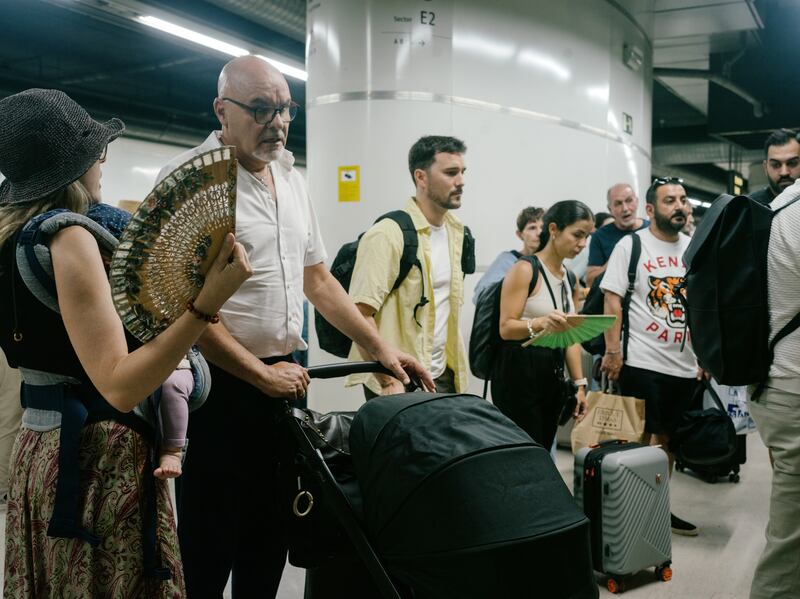
In France, where most buildings do not have air conditioning, there was a run on fans and a scramble to supply mobile air conditioners to schools, while health workers raised the alarm over high temperatures within hospitals.
Benjamin Rossi, an infectious disease specialist at the Robert Ballanger Hospital in Aulnay-sous-Bois, said that his workspace was on the top floor and that there were temperatures of 39 and 40 degrees in offices and in patients’ rooms.
“There is a risk of death to hospitalised patients, but also the risk that patients might walk out because the conditions are unbearable,” he said in a television interview.
“These are very difficult conditions to endure ... Funding will have to be found, the state will have to solve the problem urgently.”
Facing political pressure over the issue, prime minister Sébastien Lecornu acknowledged there had been a “clear delay in the maintenance of our public buildings” but argued his government was having to “catch-up after decades of underinvestment”.
The mayor of Paris Emmanuel Grégoire made a block order of 1,200 air conditioners and promised to deliver one to each school in the capital over the course of the week, so they could have at least one cool room.
Across France, 3,500 schools were shut on Thursday and 10,000 adapted their hours or the locations of classrooms in response to the heat.
Education minister Edouard Geffray said that national exams scheduled for Friday would go ahead, though with additional breaks allowed and measures taken to ensure the availability of water.
“We’re going to try to create the best possible conditions, or rather, the least unpleasant conditions possible,” he said.
As a makeshift measure, people taped up reflective emergency blankets over windows to block out the sun and prevent further warming of buildings designed to retain heat.
Green politician François Ruffin brandished an emergency blanket in a furious television interview, describing it as the “symbol” of the heatwave and of political failure either to prevent climate change or to prepare for predicted extreme heat.
“These survival blankets are put on the windows of our hospitals, in the national parliament as well, in retirement homes,” the Green lawmaker. “This symbolises the incompetence of our leaders.”


