

“What we’ve got here is failure to communicate.”
The words are spoken by the prison boss to Paul Newman, aka Cool Hand Luke, in the movie of the same name. If you’ve never seen it, put it on your list.
The boss might well have been talking rugby. We’ve been hearing a lot of communication in recent weeks, both on and off the pitch, and some of it could indeed be placed in the “failure” category.
Let’s start with Italian referee Andrea Piardi, whose yellow cards in Australia’s win over South Africa caused quite a stir. Some – who should know better – have proposed that he should not be allowed to referee Australia again. It is a case of shooting the messenger and amounts to public criticism of Piardi, who is actually a very good referee. Yes, one card was an error, but that was compounded by an over-zealous assistant.
READ MORE


One of the cards actually resulted in the disciplinary panel handing a four-week suspension to Hunter Paisami for his dangerous tackle on Sacha Feinberg-Mngomezulu. That, no doubt, will give the pundits a few more messengers to gun down, but, gentlemen, you are totally out of order.
Piardi was applying World Rugby protocols and if players do not bend into the tackle, then they are at serious risk of heading to the bin. Suggestions that players should just be put on report for head contact are wide of the mark. They also ignore completely the reality that sub-concussive knocks to the head can cause long-term brain damage. This report system, we shouldn’t be surprised, is straight out of rugby league’s playbook. Unlike league, rugby union continues after a tackle, and needs the yellow card to maintain its deterrent relevance.
If players know they won’t be going off, we will have upright tackles that prevent the ball-carrier from passing by pinning his upper arms. Such tackles inevitably increase the number of head-on-head collisions. Having no immediate deterrent will not work. There was also the fiasco of a breakdown of the communication system, which has become the comfort blanket for too many officials, particularly below the top elite guys.

The coaches have also been having a public spat, with much toing and froing about the scrum. Dave Rennie, the New Zealand head coach, claims South Africa drive illegally across the scrum, which of course is stoutly denied. It can be very hard to detect and the jury of experts has been unable to deliver a unanimous verdict.
We have also been listening to how the referees communicate. While I would never wish to clone the match officials, some ‘dos and dont’s’ are surely necessary. The difference between Angus Gardner and Nika Amashukeli was chalk and cheese. Gardner was over-friendly, trying to cajole “Malcolm” (Marx) in an effort to get him to scrummage correctly. One scrum, constantly reset, took all of four minutes before Gardner awarded a free kick. John McEnroe’s stinging riposte to a Wimbledon umpire – “you cannot be serious” – comes to mind.
In contrast, Amashukeli simply said, and did not repeat it: “Remember what we agreed.” He was referring to the chat all referees have with the frontrows before the match when the requirements for good scrummaging are discussed. I’m clueless as to why referees feel they need to verbalise it all over again once play has started.
New Zealand referee Ben O’Keeffe was in charge of Argentina v Australia, and, boy, did we hear from him. Long, loud explanations were given as to the reasons for his sanctions, and also for his decisions not to whistle. It was way over the top, completely intrusive. Similar to Gardner, it all amounted to non-stop chatter, with the officials becoming the centre of attention. This is not confined to southern hemisphere referees, as England’s Karl Dickson demonstrated in the New Zealand v South Africa match in Baltimore.
Join our Irish Times Rugby WhatsApp community

There is much talk about preventative refereeing, it’s a tricky subject. I can understand it when a player may be unsure if he has the right to poach the ball at the tackle. But, if it has already slowed down the ball, or affected play in any way, then it’s too late.
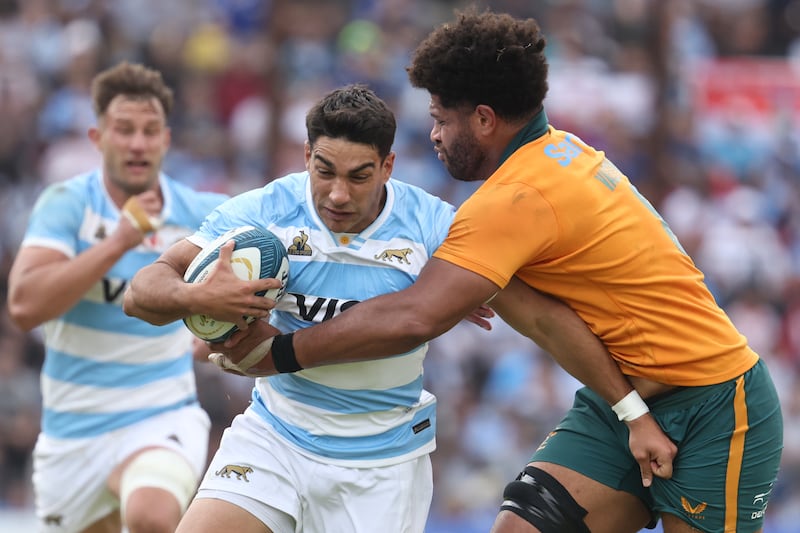
A quite extraordinary incident saw O’Keefe telling the Argentina scrumhalf, Santiago Carreras, to go back. He shouted it three or four times. On the final occasion, the player did go back, only to be immediately told that he could now come forward as the lineout was over. That was just nonsense in terms of prevention. There’s also the problem of being consistent with prevention. It’s close to impossible to be equitable to both teams across 80 minutes, and indeed from match to match and from referee to referee.
There are protocols for just about everything under the sun, so a few for communication might not go astray. It would be an opportunity to get rid of the first-name, chummy-chummy stuff and the ceaseless commentary. Lord above, is there any other sport in the world where the arbiter behaves in such fashion?
Precise, concise reasons for sanctions, delivered firmly, is the only way to go. Referees should not enter into debates. Too often we see the match stopped while the referee listens to a player give his side of the story. And it shouldn’t be just any player appealing to the referee – everything should go through the captain.
Is it too much to ask that referees adopt a less-is-more communication policy in the forthcoming Nations Championship fixtures? Probably.