
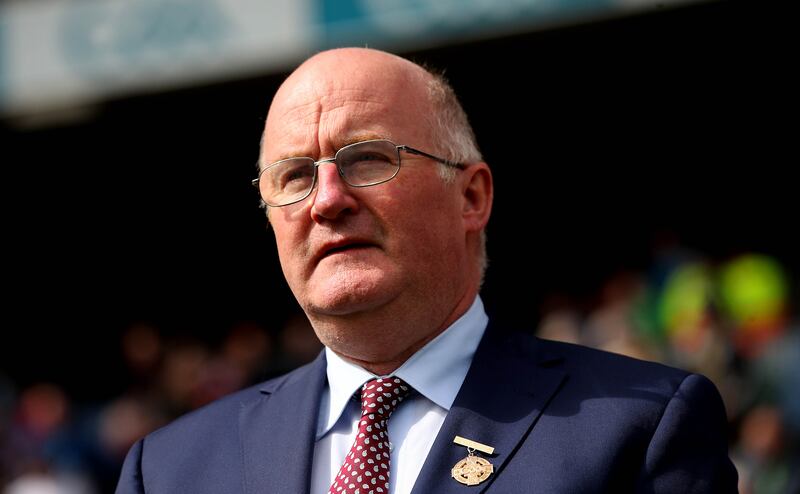
The first thing to say about John Horan is that he’s likely to do a good job as the new chair of the Integration Steering Committee. Nothing is guaranteed, of course – if it were, Mary McAleese would have stayed, and the whole process wouldn’t be snarled up like the M50 at breakfast time. But Horan is capable, willing, experienced and battle-hardened. On the basic fundamentals, he is an obvious fit for the role.
Still. Doesn’t look great, does it? The former chair of the steering committee storms out the door, complaining about a GAA management committee in which she suspects “there are people who are not entirely happy about the idea of including women in decision-making”. And their response is ... to replace her with a man.
Not just any man, either – a former president of the GAA. The whole concept of the steering committee was that three organisations were being brought together as one, hence the idea of the wrangler in the centre of it all being someone independent. Now, maybe that was the wrong framing. Maybe this was always, in reality, a GAA project requiring a GAA project manager. Whither or which, that’s what we have now.
Horan isn’t just a past president of the GAA, he is somebody who is still deeply enmeshed in various GAA projects around the country. He’s chairman of the board of Páirc Uí Chaoimh. He is on the committee in charge of building the new Louth GAA stadium in Dundalk, as well as being a director of Páirc Tailteann in Navan as it undergoes its rebuild. He has a reputation within the GAA as someone who can work with people, a wise head who is good at taking the long view and getting things done.
READ MORE


But none of that is really the point. The point is that integration is always going to be as much of a selling job as a doing job. It’s not just about the association making things right – it’s about them being seen to make things right. That’s a more difficult thing to achieve when you choose as a figurehead someone who looks like a GAA man, who sounds like a GAA man, who literally is the quintessential GAA man.
They do themselves no favours sometimes. How often during the skorts wars of 2025 did you find yourself correcting ordinary members of the public, informing them that this actually has nothing to do with the GAA and that it was, in fact, a camogie problem, created by a separate organisation called the Camogie Association? That drove people within the GAA to distraction – and rightly so.
The same will happen here, you can be sure of it. Appointing John Horan was a choice made by all three organisations, but that’s not how it looks. Instead, it looks like the GAA deciding that they’re done with outsiders coming in and making a hames of the thing so they’ve put one of their own in charge of it. Try convincing people otherwise, see how long they listen.
Optics matter. The optics here say one of three things. Either (a) they couldn’t get a woman to do the job; (b) they couldn’t think of a woman to do the job; or (c) it didn’t occur to them to get a woman to do the job. None of those are good.
They are particularly not good in the context of McAleese’s departure. Even if some of her comments as she left the stage were unfair and overblown, there’s no getting around the fact that they set the agenda for what happens next. One of the most high-profile female leaders in the history of the State, someone who has always been well-disposed towards the GAA, called them out in the most public way possible. And their response is to ask an ex-GAA president to do her job.
Again, this is nothing against John Horan personally. There’s a good argument to be made that he would have been the right person to get in from the start. McAleese seemed like an inspired appointment, but instead maybe they should have recruited Horan, or someone like him – a native speaker when it comes to navigating the spaghetti junction of Gaelic games admin.

But that’s not what happened. And the reason it didn’t happen was because they made the determination, not unreasonably, that a good way of signalling their intentions around integration was to put a strong female face and voice front and centre. It was a decent idea then, and it hasn’t stopped being a decent idea just because the last woman criticised them in a radio interview.
This isn’t about tokenism. Or at least it shouldn’t be. What it should be about is the GAA acknowledging its original sin. If you were designing it from scratch now, of course you’d make the association fully integrated from the get-go. Times were different in 1884 and for a long time after. But we are in 2026 now, and the idea that all the distaff options were exhausted before turning to an old-hand GAA man just feels unlikely.
This will blow over. It always does. The steering committee will get on with its work and somewhere down the line, integration will get done. None of that was ever in doubt. The questions were only ever around the way and the how and the who.
The GAA decided to play it safe on the last question. If they wish to prove Mary McAleese wrong in her accusations, this wasn’t the way to go about it.