

Boys are not great talkers when it comes to serious stuff. Speaking as one myself (let’s face it, most men are just adult boys, right down to the laughing at fart jokes), we are great at deflecting. Avoiding deep questions is our stock in trade.
Add to that a general reluctance in society towards acknowledging specific problems facing boys and men.
Boys are falling behind in education, and men in lower socio-economic groups have been particularly badly hit by reduced incomes and rising job insecurity. As economist Richard Reeves writes in his book Of Boys and Men, these problems are “structural in nature, rather than individual” but they tend to get sidelined in modern debate on gender.
“We can be passionate about women’s rights and compassionate toward vulnerable boys and men,” Reeves points out.
READ MORE


So how do we break down defences against discussing men’s issues. How do we conduct necessary conversations with boys about their purpose in life and their ideas of manhood? This is a serious challenge for parents and educators.
For advice, Unthinkable turned to Robert Grant, founder of Hearlisten, which brings the practice of philosophical dialogue to schools and community groups. Between 2020 and 2025, he ran different sets of dialogues with boys and young men for a project called What Does He Need?, which was hosted by artist and educator Fiona Whelan, Rialto Youth Project, and Brokentalkers, an artistic project exploring societal influences on men and boys.
Grant, who holds a PhD in philosophy from TCD and advocates for philosophy in schools, has some lessons for the rest of us from the experience:
What questions would you use to start a conversation about masculinity with boys?
“When discussing masculinity with boys and men, we found it best to approach the subject obliquely, to come at it indirectly. To ‘tympanise’, as French philosopher Jacques Derrida put it: the tympanic membrane is stretched at an angle over the ear drum, creating a greater surface area and finer precision in hearing.
“So, instead of going head-on into ‘What is a man?’ or ‘What is masculinity?’... we generated a set of philosophical provocations used to spark dialogue. For example, ‘It is a man’s responsibility to protect those he cares for’, or ‘Men are not as strong as they used to be’, or ‘To be a man is to act like a man’, along with themes of violence, identity, and power.
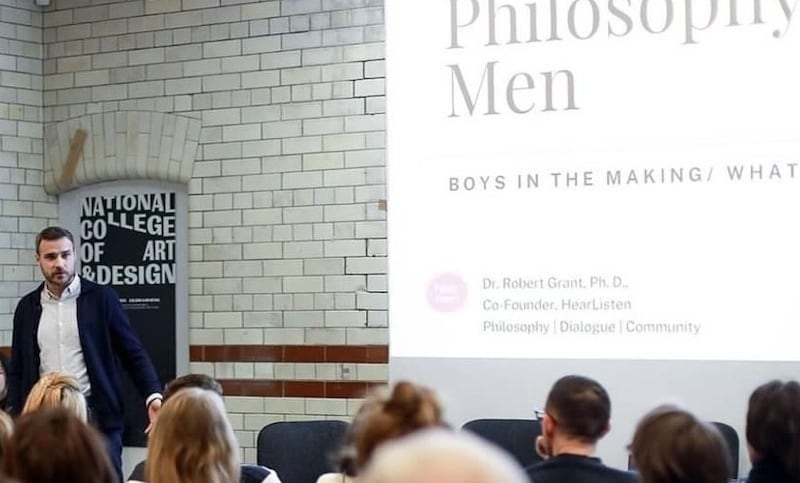
“These statements invite participants to take an initial stand on a particular issue. But once the conversation starts to flow – with careful guidance – the focus inevitably shifts to the assumptions behind those ideas: what is strength? What is care? Where does responsibility come from? Is showing weakness a sign of strength? Is masculinity a performance? Who protects the protector?
“Through these more abstract discussions a view of masculinity emerges, but not in a reductive or prescriptive way. Rather, the dialogue creates space for contradictions, complexity and nuance to emerge. We are not seeking to arrive at a definition of masculinity, but creating an opportunity where boys, or men, can question their assumptions together.”
What are the things to look out for – or to guard against – to ensure it’s a healthy dialogue?
“The health of a dialogue is in direct proportion to the quality of listening that takes place. Too many of our conversations in life, and specifically with young people, tend to be one-way ... ‘Anyone who listens is fundamentally open’, as German philosopher Hans-Georg Gadamer put it.
“This involves letting go of control, of predetermined agenda, of any attempt to impose your view, and taking the risk that you might hear things you don’t expect, you don’t fully understand, you don’t agree with, or that you find uncomfortable.”
[ Unthinkable: Is science being skewed by a gender bias?Opens in new window ]
How do you deal with a conversation if someone says something problematic?
“This can happen just as easily with fully grown adults as with young people. In our practice, we err on the side of openness. We try to avoid moralising or policing thought, which can lead to defensiveness or shutting-down ... It may push people back into those reductive, simplified, echo chambers where views are reinforced.

“But deciding not to moralise is not the same as allowing ideas go unchallenged. Within the methodology of philosophical dialogue lies the obligation to justify your views with reasons. Our approach allows the burden of proof to fall back on those ideas by asking deeper questions: What do you mean by that? How do you define that term? Are there any exceptions? Where do those ideas come from? What if everyone thought that way? Who benefits from people believing that?
“Often times, strongly held views find themselves on shaky ground in the face of genuine critical investigation. This exchange is not done to ridicule or humiliate either. It’s not about winning or ‘gotcha’ moments. It is about taking someone’s ideas seriously enough to warrant thoughtful critique so you can get closer to truth, rather than simply dismissing.”
What else have you learnt from the work?
“I am aware that the potential of philosophical dialogue to reach young boys and men is limited. We are dealing with young, intelligent, vital, energetic boys with access to an infinite amount of mesmerising, exploitative content streamed directly into their consciousness.
“They are caught at a historical moment where late-capitalist, hyper-individualised society has left them with a dwindling sense of community, purpose, and meaning. The world is literally burning thanks to the adults who’ve been managing it. These boys need much more than just conversations, but it is definitely a good place to start.”


