‘I’m still struggling with the fact that some people consider me a symbol for resisting this administration,” Mahmoud Khalil tells me from his home in Brooklyn.
Khalil, who is speaking with me from his one-year-old son’s bedroom, is soft-spoken and gracious – somewhat sheepish, even. So much so that it’s easy to forget that he has become one of the most recognisable faces of the organised resistance to the Trump administration. It is also easy to forget that he is mired in a series of immensely high-risk legal cases against both the administration and his alma mater, Columbia University.
Khalil speaks calmly throughout our conversation about his legal troubles and his uncertain future in the US. He was arrested last year and detained for more than three months. He was not charged with a crime but it was alleged by the administration that his pro-Palestinian organising constituted a national security threat. These events are detailed in his new memoir, No Land to Stand On: Notes from Detention. The memoir – which jumps back and forth between his time in an Ice detention centre in Louisiana, to his adolescence in a Palestinian refugee camp in Syria, his decade spent living in Beirut, and, eventually, to New York – is destined to become a staple of dissident literature and an important record for future historians of the second Trump administration. No Land to Stand On, which was born out of the diary entries and observations Khalil recorded during those nightmarish 104 days, is his first book.
[ US immigration judge rules Palestinian Columbia student Khalil can be deportedOpens in new window ]
“There is so much in my life that could have been included,” Khalil says of his decision to withhold much of his life story and instead focus on the events surrounding his arrest. “I lived in Beirut 10 years and I only mentioned it in a few pages.” Also only mentioned are his family’s expulsion from Tiberias (now part of Israel) during what Palestinians call the Nakba – the mass displacement and dispossession of Palestinians during the 1948 war surrounding the creation of Israel – and the multigenerational story of loss and displacement that followed as they moved across Syria, Algeria and Germany (where his parents now live) – itself worthy of a book. He devotes more time to his adolescence in Syria, where he and his friends became politically engaged during the 2011 Arab Revolutions and began taking part in pro-democracy protests against dictator Bashar al-Assad. That same year, when he was 16, Khalil was shot in the leg by Israeli security forces, when he, along with hundreds of others, marched towards the border Syria shares with the Israeli-occupied Golan Heights to commemorate the Nakba.
READ MORE


The violent reality of political dissent is never far from Khalil. In 2013, as Syria was engulfed in civil war, he learned that two of his friends had been disappeared by Assad’s security forces. That same day, fearing for his own life, he packed a bag and crossed the border into Lebanon. He had the equivalent of less than €1 in his pocket when he began his new life. More than a decade later, a few months after Assad was eventually deposed, Khalil learned that his two friends had been killed under torture. “They were in the wrong place at the wrong moment, and I had been in the right moment,” he writes in No Land to Stand On. “That was the only difference between us. I made it to Beirut. I made it to New York. They never made it home.”
He then spent much of his twenties living in Beirut working in various jobs, including at the British consulate, picking up French and English along the way. In August 2020 the Beirut port explosion levelled parts of the city. It blew out all of the windows and glass in his apartment. “I was this close to being killed,” he says. Years earlier Khalil met Noor Abdalla, the woman who would become his wife – a Syrian-American who had grown up in Michigan, who was studying to become a dentist – while she was volunteering at an educational programme in Lebanon for Syrian refugees that was being managed by Khalil. They maintained a long-distance relationship for several years, crossing the Atlantic once or twice a year to see each other. In 2022 Khalil received a place at Columbia University’s School of International and Public Affairs and he moved to New York, he says, seeking “stability and permanence”. The couple married a year later, making Khalil a green card holder.
When protests and counterprotests began at Columbia following the bombing campaign Israel launched in response to the October 7th attacks, Khalil – already affiliated with the campus’s Palestinian organisations – unwittingly found himself both a spokesperson for the students and a go-between with the university. As tensions rose on the campus, and Columbia permitted the New York Police Department to enter and remove pro-Palestinian encampments, he (along with several others) was targeted by pro-Israeli groups. While many students chose to wear face coverings to minimise their chances of having identifying information published online or being expelled, Khalil chose not to.
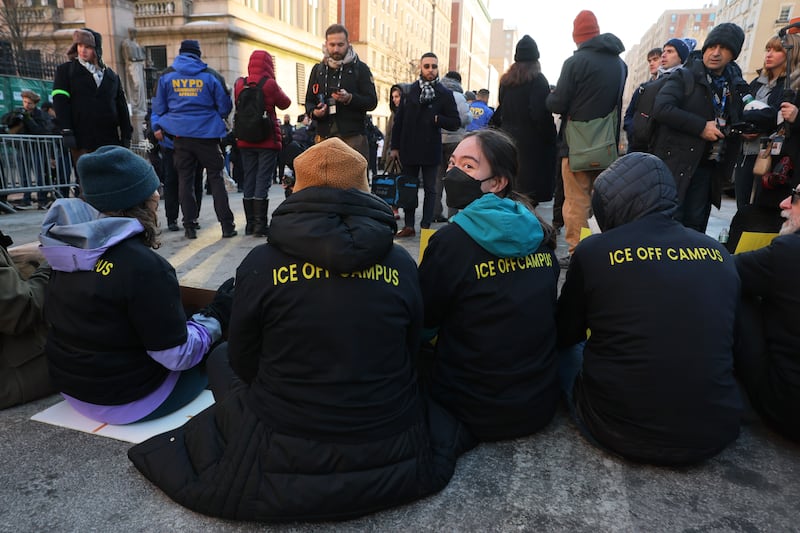
The pro-Palestine campus movement of which Khalil found himself in the centre was composed of several different groups with a wide variety of opinions. Because of his close relationship with the movement, Khalil was, by association, accused of extremist views that he has never supported or endorsed. “I know I have views that would differ from a lot of the people in the movement itself, given just so many experiences through life that shaped me in so many different, very nuanced ways,” he says. “ I don’t want to let people down when they discover, for example, I’m not a supporter of Hizbullah or of Iran for their role in Syria, where I was subject to their atrocities.” What mattered most to him was raising awareness of Israel’s war on Gaza and its occupation of the West Bank. Months later, in March 2025, he and his wife were returning to their apartment one morning when Ice agents arrested him and he was detained.
Beyond seeking to deport Khalil – who had no criminal record – he believes the administration wanted to chill speech and remind people that it could marshal the levers of government against anyone who dared criticise its policies: “The king wanted to send a message,” Khalil writes, “and I was the messenger.”
But, Khalil says: “This government is incompetent. The fact that they did not know I had a green card before coming to arrest me ... ” Noor was eight months pregnant when agents came to take Khalil away, and says he was refused supervised day release to witness the birth of his son. “They’ve already ruined my life, and the moments I lost in detention I would never get back.”
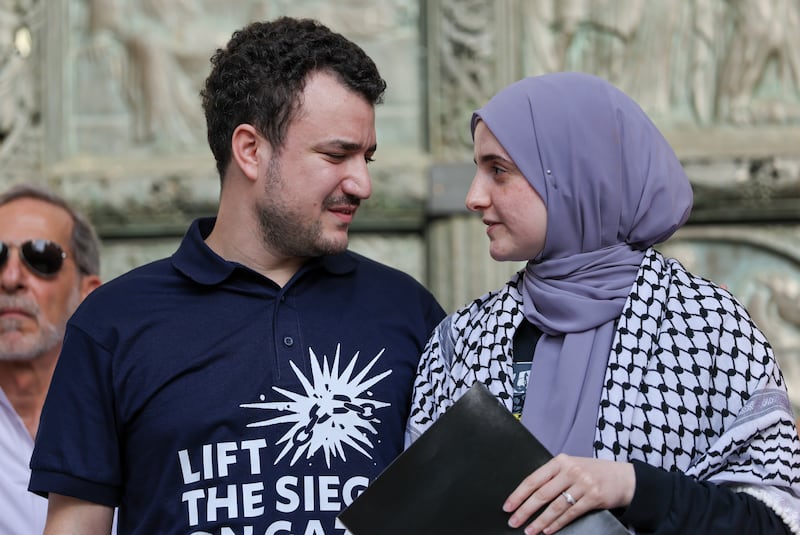
In response to this and ongoing efforts to deport him, Khalil has brought several legal cases against the US government, challenging the legality of his deportation order, which has been variously dropped and upheld by different courts. As part of his legal strategy, Khalil is using the Ku Klux Klan Act of 1871, which banned law enforcement agencies from partnering with private groups to conspire and deprive citizens of their constitutional rights. Khalil alleges that the “government acted upon a conspiracy with right-wing groups” to target and attempt to deport pro-Palestine activists. Most recently he launched another lawsuit against Columbia University, alleging that it failed to protect students who supported Palestine from harassment and doxxing (publishing identifying information about an individual on the internet), campaigns. Khalil has stated that any proceeds from these lawsuits would support others who have been targeted.
Is he worried that suing the administration will invite retribution? Of course, he says – but he’s more worried about what happens if he doesn’t stand up for himself and others like him who choose to speak out. “To me, they poked a bear,” he says. “I want to make an example out of them. But of course I’m afraid. Courage to me is not about not being afraid. It’s about doing the right thing despite the fear.”
“This administration,” he adds, “act like bullies, and our parents teach us with a bully you have to fight back because they won’t stop.”
While he has been overwhelmed by the support he has received since his detention, he is not totally surprised by it. “I’ve been part of this movement for so long and I know that there’s so much care in this movement. People actually care about each other. I’ve seen the jail support, the encampments, how people showed up for students when they were arrested.” He writes in the book of how a wide network of people came together to support Noor and their son while he was in detention. That network has grown bigger since, with some of the US’s most prestigious civil rights organisations and specialised advocacy groups, such as the American Civil Liberties Union (ACLU), the Center for Constitutional Rights and others taking his cases on. A lot of his time, he says, is now taken up with legal proceedings along with their attendant meetings and preparations.
While he will be promoting his book, he keeps a relatively low profile these days. Despite how drastically his life has changed, he appears positive and determined about what lies ahead. He is keenly aware that he is, in his own words, one of the luckier Palestinians. “I’m still one of the privileged ones, actually, who’s now in the United States. I have a roof above my head.”

When I ask what’s next, he says he’s not sure – he is taking things day by day. I tell him it sounds like he has enough stories to fill several books. “We’ll see,” he says, laughing. Years of compartmentalising his emotions – a result of growing up in a refugee camp, being shot by Israeli security forces, witnessing friends being disappeared by the Syrian security forces, being thrown in prison and, most recently, learning that his future in the country in which his wife and son are citizens is contingent on the outcome of very lengthy, very costly legal battles – has made accessing his emotions and the act of writing difficult, he says.
There will be no straightforward route back to a life in diplomacy after what he has endured, that much seems sure. Though, by seeking to suppress and deport Khalil, the administration may have strengthened his resolve to find a different, perhaps more impactful, way to continue with what he sees as his calling. “Whether it’s through [being a] diplomat, whether it’s through writing, whether through leading protests, whether through a grassroots movement – it all serves the same purpose,” Khalil says. “Which is advocating for the rights of the Palestinian people, for Palestinian liberation, for the end of the occupation.”
No Land to Stand On: Notes from Detention is published by Picador