At 3.05pm on August 15th, 1998, Lance Corporal Errol Thompson made a note in the logbook at Lisanelly army barracks in Omagh.
“A large bomb exploded,” he wrote. “Location unknown.”
It is the first written record of the explosion that, only a minute before, had devastated the centre of the Co Tyrone town and that, it was immediately evident, had caused multiple deaths.
The death toll was one of the worst in the history of Northern Ireland’s three-decade Troubles. The bombing killed 29 people, including a woman pregnant with twins, and injured hundreds of others in the Real IRA atrocity.
READ MORE



How it happened – and how it could have been prevented – is being pieced together in evidence at the Omagh bombing inquiry at a Belfast court.
Royal Ulster Constabulary (RUC) constable Alan Palmer previously described the moment of the bombing to the inquiry as “a flash of light, a great suction and a great, piercing pain in my back” as he was hit by shards of glass from shop windows.
He remembered “seeing all the people who were in front of me lying dead, and those who remained alive had sustained serious injuries”.
Another former soldier, former captain Michael Peebles, recalled hearing “screams and cries” as they listened in to the RUC radio in the barracks ops room.
“It was pandemonium, understandably,” he said.
The inquiry heard the British army was not notified about the bomb warnings by the RUC, Northern Ireland’s police force at the time, but learned of them from listening to that same radio, as was the custom at the time.
It also heard soldiers were not deployed to Omagh until after the bomb exploded because they were not requested by the RUC, again in line with procedure.

“Had the RUC immediately requested your support ... at 14.30 could you, in theory, have had 15 extra bodies and 15 extra sets of eyes on the streets of Omagh?” barrister Stephen Toal, representing some of the bereaved families, asked Peebles.
“Yes,” he said.
The barrister replied: “And we will never know if the outcome could have been different.”
This is an independent public inquiry, which opened in 2024 and is charged with examining whether the atrocity could reasonably have been prevented by British state authorities.
This week it passed the halfway stage of its current evidence session, which is looking at how the bombing was carried out, and by whom.
The inquiry’s working hypothesis is that, while the Real IRA “was responsible”, at an “organisational level, both the Real IRA and Continuity IRA planned and carried out the Omagh bombing”.
[ Omagh inquiry names 27 ‘key individuals’ related to 1998 bomb attackOpens in new window ]
It has identified 27 “key individuals” – 14 of whom have convictions for terrorist offences – including Michael McKevitt, Colm Murphy, Seamus Daly and Liam Campbell – who were found liable in a civil case for the Omagh bombing – and Seamus McKenna, who was found not liable but who, according to that hypothesis, “played a key role”.
The inquiry considers there are “sound reasons” to believe Seamus McKenna was in the bomb car and Seamus Daly in the scout car, and its “working hypothesis” is that Liam Campbell “either made, or was responsible for causing to be made, the warning calls”, said lead counsel to the inquiry Paul Greaney.
“Sat like a spider at the centre of the web of the plan to detonate a bomb in Omagh” was Colm Murphy, the barrister said.
The inquiry has viewed a detailed timeline compiled by inquiry analyst Mark Safranauskas, which used available data, including from the Police Service of Northern Ireland, An Garda Síochána and the British army, to name those they believe to be responsible, and the links between them.
The presentation tracked the progress of the bomb car and scout car on the basis of data from mobile phone cell sites.
It showed handsets connected to McKenna and Daly moving over the Border to Omagh on the day of the bombing and reappearing on the southern side of the Border after the explosion.
But, as the inquiry has highlighted, much remains unknown, not least their precise route, as there is “no conclusive eyewitness testimony” nor CCTV footage.
Testifying before the inquiry, Det Supt Emmet Casserly of the Garda agreed that the force’s investigation was not able to “establish definitively” where the so-called bomb car was taken after the theft, where it was kept or where the bomb was loaded.
He also agreed with Greaney that “although it is thought that the bomb car was accompanied by a scout car”, there is no evidence “conclusively to confirm there was another vehicle”.
It is not known where precisely the bomb run began, nor where the cars crossed the border, though it is believed to have been at Aughnacloy, Co Tyrone – 32km southeast of Omagh.
The inquiry was told the bomb car was not on the footage from the permanent British army checkpoint at Aughnacloy, but that it was not recording for about 25 per cent of the time and did not always capture every vehicle.
The bomb and scout cars are believed to have crossed the Border between 1.13pm and 1.29pm on August 15th.
The inquiry heard an eyewitness later told police he noticed two cars parked on the side of the road outside Omagh at about 2pm.
He said “two males ... were reading a map on the roof of the Corsa” and another man was in the passenger seat of a “dark red or maroon Vauxhall Cavalier” that matched the description of the bomb car.
Det Chief Insp Peter Billingsley, who gave evidence to the inquiry as a corporate witness on behalf of the PSNI, confirmed there was no investigative follow-up of this sighting and the second car – potentially the scout car – was never identified.
“The sighting was effectively set aside,” a barrister said.
Other eyewitnesses reported seeing what they believed was the bomb car in Omagh from about 2pm. That included one woman who believed the driver of the car allowed her and her young daughter to cross the road, and thought “it was decent of the driver”.
Another eyewitness, Ruth Buchanan, thought she saw the car parked in front of her on Market Street, and the driver and passenger get out and walk away from the town centre.
She had the impression they were in a hurry, but the passenger “caught eye contact with her and grinned with her”.
“He was calm and relaxed,” she said.
“The driver was standing staring down Market Street ... He appeared to have a serious expression on his face.”
The first of three warning calls was made to UTV from a public call box in the Newry area at 2.29pm.
The member of staff who answered the phone told police a man said: “Bomb, courthouse, Omagh Main Street, 500-pound explosion, 30 minutes”, and giving a recognised code word used by dissident republicans.
The police deployment began at 2.32pm and a “clearance operation” commenced outside the courthouse, the inquiry heard.
Billingsley told the inquiry the inaccuracy of the locations given in the warnings was a big contributor to the loss of life.
“It caused the evacuation to ultimately direct people towards the bomb,” he said.
When asked about the timer on the bomb, he said: “More time could have been given had the timer knob been turned fully.”
At 2.58pm, the RUC confirmed the streets near the courthouse “had been cleared and sealed off”.
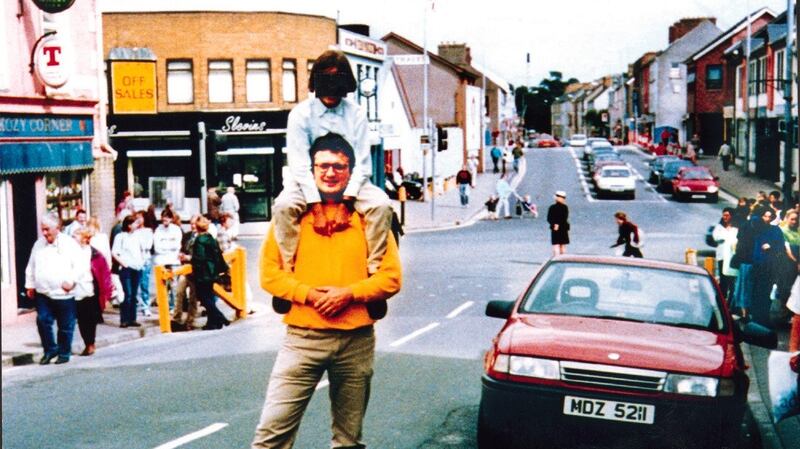
The inquiry was shown a photograph, taken in those final six minutes, of a man with a child on his shoulders, both smiling, and in the background, the car containing the bomb.
At 3.04pm, it exploded.
The inquiry continues.