
French toast is offered to visitors at Drumcree Community Centre in Portadown when they walk through its doors on a mild-September morning.
Sunflowers grow outside the whitewashed building where children’s scooters are abandoned beside wooden swings on a grassy play area.
This is the centre in the Co Armagh town that became a hub for residents living in the mainly nationalist Garvaghy Road area at the height of a dispute over an Orange Order parade during the late 1990s.
There has been relative peace since then.
READ MORE


But a fresh application by the Portadown District of the Orange Order for a silent, “limited” procession along the Garvaghy Road at the end of this month has reignited tensions.
More than 100 residents packed out the centre’s main hall to support a petition against the march the previous evening.
Among them was a teenage boy worried about the impact on playing for his football team.
“It’s hard to put into words the anxiety and fear this has created across generations,” says Linda O’Neill, the centre’s manager.

Pensioners have approached staff with concerns about leaving their homes.
“Some older people have said they’ll not get the bus up the town or will cancel their doctor’s appointment until this all settles down. That worries me,” says O’Neill.
“We have a young volunteer who is a fantastic wee footballer. He plays for a team that is mostly Protestant and he turned round last night and said: ‘Am I going to have to stop playing?’ He’s 16. He has friends and a life outside of here.”
O’Neill (51) has worked at the centre for almost 30 years and grew up on the Garvaghy Road, an epicentre of sectarian tensions during Northern Ireland’s Troubles.
When she was a teenager, she recalls going into Portadown town centre where some shops displayed job signs with “Catholics need not apply”.
“I’m not talking about the 1950s. I’m talking about the 1990s. Those businesses are now gone. We’ve moved on. We’ve had 28 years of peace,” she says.
“Anybody that hasn’t been here and lived it does not respect the trauma, the intergenerational trauma that is here.”

She received hate mail the night before we meet.
“Someone got my personal phone number. You couldn’t repeat what they were calling me,” she says.
“I haven’t said anything derogatory about Protestant people or the unionist community. What I’m talking about is this specific parade. For me, it is a sectarian march.”
In the middle of the room, copies of the petition are stacked; it will be translated into other languages including Portuguese and Polish to reflect the town’s changing demographic.
“These people need to feel included,” says O’Neill.

Serving food from the kitchen hatch, Nuala Halfpenny hasn’t slept in 24 hours.
“It’s getting too real,” she says.
“This community and the other side of the community have come too far in 28 years. I don’t think there’ll be violence as a consequence. The consequence will be about relationships.”
It is Tuesday, five days since the Orange Order announced its plans at a press conference in the town.
If successful in their bid, it will be the first time Orangemen have marched the contentious route on their return leg from Drumcree Church in 28 years.
“I’m waking every morning with anxiety. I feel physically sick at the thought of it,” says Maxine Cusack.

Pouring cups of tea from an enormous silver teapot, the 64-year-old lives off the Garvaghy Road and is worried she will have to “shelter my grandchildren” from potential trouble.
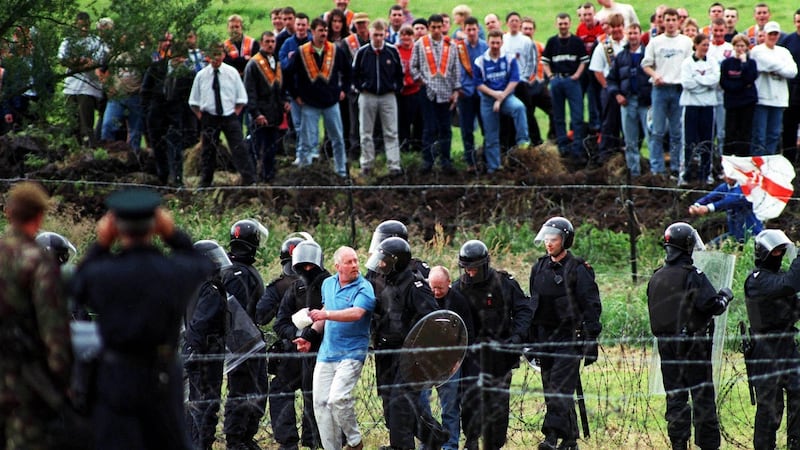
Cusack was among the residents barricaded in by armoured RUC vehicles and British soldiers amid the massive security operation during the summers of the late 1990s.

The Drumcree protest began in 1995 with images of violent clashes beamed around the world. The dispute ended in 1998 after three Catholic children – Richard, Mark and Jason Quinn – were killed in a petrol-bomb attack on their Co Antrim home. They were among 21 sectarian murders linked to the dispute between 1996 and 1999.
“I don’t think the trauma at the time had as big impact as now. I think it’s worse when you’re looking at it again,” says Cusack.
“I had three children under the age of eight and I moved them out during those summers to a caravan in Warrenpoint with my sister. Now I have a son in a mixed marriage.

“The number of mixed marriages in this area – that didn’t happen 30 years ago.
“I’m driving round the town seeing young girls mixing with kids their age from other communities ... it’s totally different from my day.”
[ Drumcree dispute led to one of worst Troubles atrocitiesOpens in new window ]
Drumcree is the longest-running parades dispute in Northern Ireland.
Yet the Tricolours that once flew from lamp-posts along the Garvaghy Road during the stand-off have disappeared.
Today, two newly erected home-made flags emblazoned with images of Orangemen are attached to railings at the end of the road close to the junction of Drumcree Road.


“Orange Feet off our Street,” one reads. “Re-route” is daubed in white paint on the other. Underneath it says: “No talk, no walk.”
One of the most striking changes in the area is the increase in new housing developments off the Garvaghy Road over the past 25 years.
“This was all rose fields back in the 60s,” says Breandán Mac Cionnaith as we drive past Rose Cottages.
Sprawling redbrick developments have been built since 2000, he says.
“These are brand new estates off this road, off the Dungannon Road and the Drumcree Road that weren’t there the last time the Orange Order marched.”

The Spires is the newest estate where prices for a detached house start at £335,000.
“The amount of housing that’s here since Drumcree is unbelievable. If a march was pushed through without the consent of the people living here, all those areas would have to be sealed off to stop anybody getting out.”
Mac Cionnaith has been the public face of Garvaghy Road Residents Coalition for three decades.
[ Newton Emerson: Progress that appears solid can be all too easily undoneOpens in new window ]
He rushes to meet The Irish Times in his office on the Garvaghy Road, saying he “couldn’t get up the road”.
“Everybody’s stopping me asking, ‘what’s the latest?’ Are they getting back down?”
“I tell them, ‘I hope not’. There’s no justification for a parade.”

In its notification to the Northern Ireland Parades Commission, the Orange Order said it would hold a “dignified and non-triumphalist” procession without bands on Sunday, September 27th.
It will be “proportionate, inoffensive and wholly reasonable”, it states.
Instead of 400 members and two bands, the parade will be scaled back to “60 persons wearing collarettes and no other regalia”.
The Orange Order did not respond to requests for comment from The Irish Times.
In a press conference following the announcement of its plans earlier this month, Portadown District Master Nigel Dawson rejected suggestions that their rights were more important than the rights of Garvaghy Road residents.

It is about a “rebalancing” of rights, he argued.
There will be no threat of violence or disruption from “any section of our community” regardless of the outcome of the application, he said.
The order has walked the route since 1807.
“More than 800 men in this [Orange Order] district all live and work in this town ... So we’re very much not competing on rights,” Dawson told reporters
“We’re very much competing on shared space, equality, respect, tolerance, that our culture, our heritage, is as important as everybody else’s – and theirs [the residents] is important too. We recognise that.
“So we’re not competing for rights. We simply want to balance them.”
The re-emergence of the old Troubles-era dispute was sparked by a scathing legal ruling against the Northern Ireland Parades Commission last month which resulted in a judge quashing its most recent determination to ban the parade along the nationalist route.
[ North’s High Court quashes Parades Commission Drumcree determinationOpens in new window ]
The commission, which adjudicates on contentious parades across the North, was set up by the UK government as a direct result of Drumcree.
It has blocked the order from marching along the Garvaghy Road in July every year since 1998.
Commissioners are expected to announce their decision on the latest application four days before the proposed September 27th parade.
Last Friday it emerged the commission is seeking to appoint an independent mediator to facilitate talks aimed at breaking the near 30-year standoff.
It was complete and utter fear for many families during that period in the 90s
— Breandán Mac Cionnaith
Mac Cionnaith is preparing to contact the body before 5pm on Tuesday; he will not be drawn on whether they will take part in the mediation.
“There will be a number of questions that will arise but that’s between ourselves and the Parades Commission,” he says.
“We want to know the background and qualifications of this mediator – and if they have ever done anything for the British government.”
The timescale for appointing a mediator is “very tight”, he adds.
“Who are you going to have in two or three weeks while we’re doing the petition around here?”
[ The resurrection of the Garvaghy Road disputeOpens in new window ]
Portadown District Lodge has agreed to participate in mediation.
Mac Cionnaith says the events of the past fortnight have retraumatised the community.
“It was complete and utter fear for many families during that period in the 90s,” he says.
“If you take it, those people who were preschool/primary school age 28 years ago; they’re now the parents of young kids themselves. They saw what their parents had to go through. And they don’t want their children having to see the same.”
In the Drumcree Community Centre, a young woman arrives on Tuesday afternoon.
Dressed in a striped twin-set, her face flushes with embarrassment when asked for her reaction to the Orange Order proposal.
“I work in a place where it’s all Protestant, I’m the only Catholic so I can’t give you my name,” says the 25-year-old.
“But I think it’s mad. The fact they want to go down the road and start all this again, I don’t understand. You see videos from the time on social media, it’s awful.
“When I was growing up, I was friends with everybody. It was never like, ‘you’re a Protestant and I’m not going to talk to you’.
“I just think everybody’s mixed now and this is going to cause a whole divide again.”


