Visions
Peacock stage, Abbey Theatre
★★☆☆☆
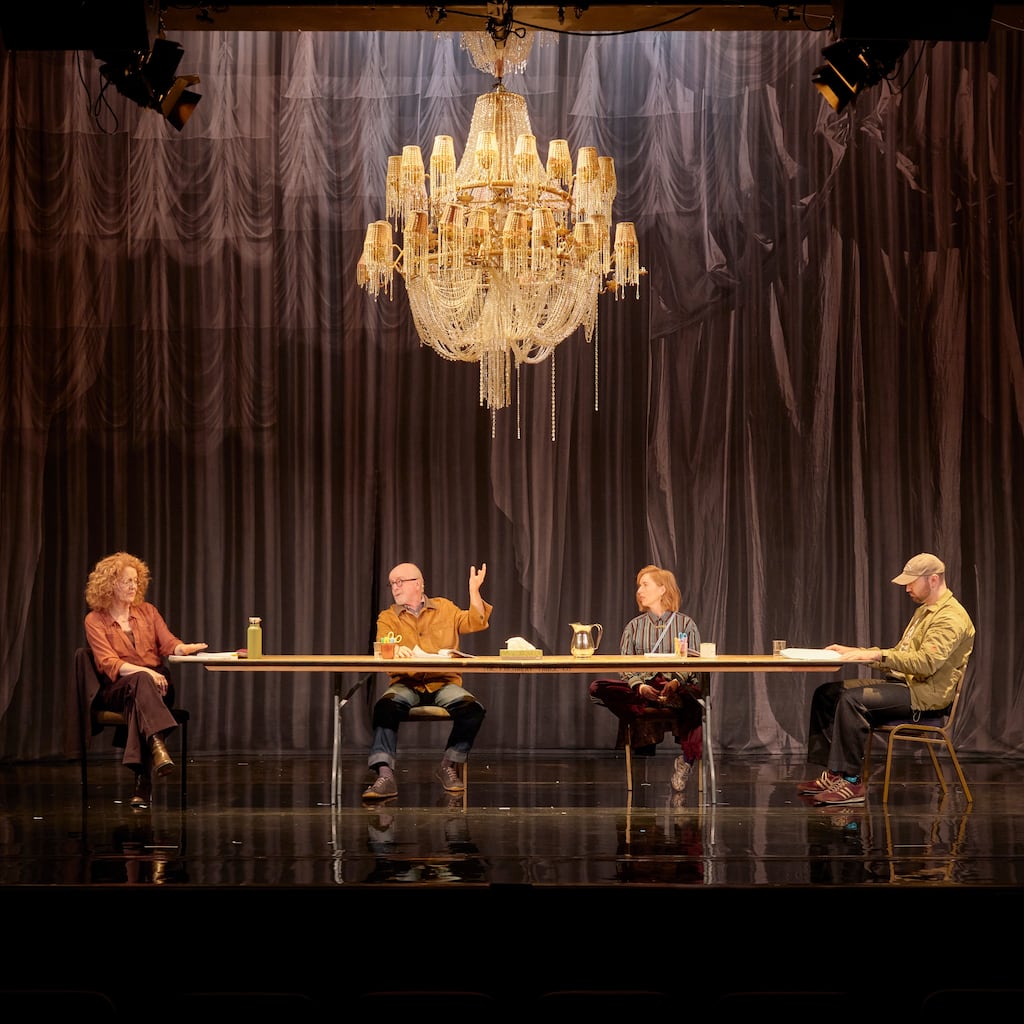
Early on in Visions, the narrator tells us that the play is set in the basement of an old Georgian building in Dublin. Yet the stage is a sparsely furnished rehearsal room. And an enormous chandelier hangs above it. So where are we, exactly, and at what point does it all become a play? These questions hang over Eoghan Quinn’s play like a big, symbolically loaded lighting fixture.
Visions is presented as a rehearsal, with actors reading from a script. Denise (Derbhle Crotty) is project-managing the renovation of what was once a dance hall in the north inner city. She’s part of the sandwich generation, caught between caring for a parent and her embarrassing relationship with a younger man.
To do the job, she has charitably enlisted a friend of her late father, the gruff yet sentimental Tadhg (Mark Lambert), who is less interested in conservation than in preservation – he has too many memories of halls like these to actually finish the work. To make matters worse, the room is being renovated for a gormless thirtysomething tech bro (Oliver Flitcroft). A millennial activist named Aimee (Lauren Larkin) would rather see it become a space for creatives.
The faded dance hall becomes a stage for competing visions of Dublin, while the real city outside is convulsed by far-right rallies, water-charge protests, terror attacks and, perhaps most menacing of all, Leinster rugby fans.
READ MORE


After Denise leads a particularly effective mindfulness session for the group, Visions starts to shift formally. The rehearsal room becomes a liminal space where dreams of the past and visions of the future unfurl and collide.
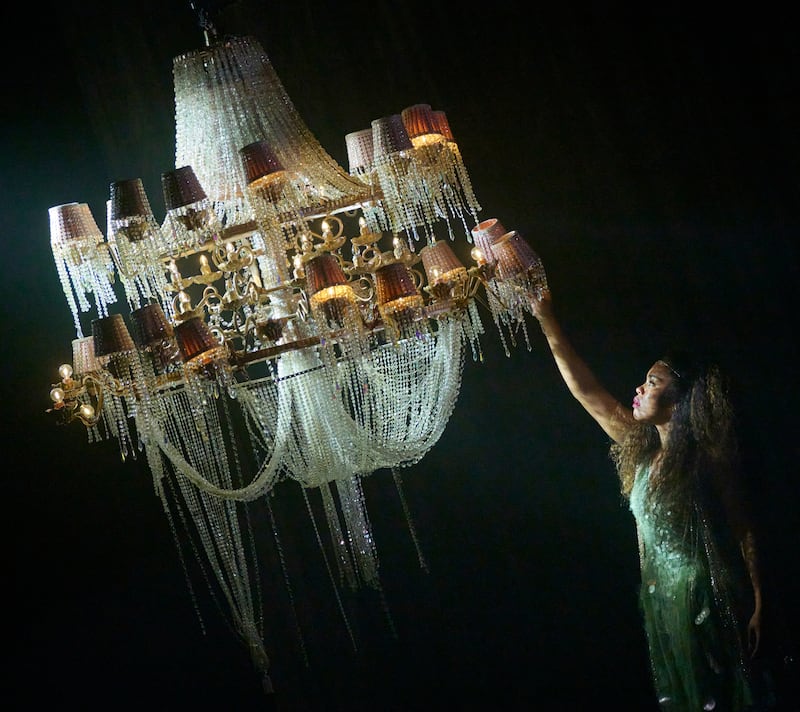
The narrator (Ghaliah Conroy) tries to maintain some structure, through words and movement, before the boundaries between character, text and set dissolve. It’s less a play within a play than a play without a play.
As director, Claire O’Reilly deftly guides us through this metamorphosis, helped by Katie Davenport’s lithe set and John Gunning’s deceptive lighting design.
Visions has a lot to say, and in O’Reilly’s hands it makes its points well. Perhaps too well. No moment or prop is safe from being loaded with meaning about life in Dublin or the mechanics of theatre. Rarely has so much been asked of a lamp.
If the set is mostly sparse, the script is crammed. Quinn’s text asks big questions about what we preserve and what we reinvent, in our city and in ourselves.
It also includes so many observations about life in contemporary Dublin that it feels more like hot-button bingo than a play. Vulture funds; no spaces for creatives; Irish men can’t express their feelings: it’s all there. The observations on generational divides, which are of the older-people-have-trouble-using-smartphones variety, are also familiar.
Visions has strong performances, particularly from Crotty and Conroy, and is occasionally funny. But with everything in service of theme and idea, the play becomes schematic. Its characters seem to exist only to make a point, never developing beyond what they’re supposed to represent.
For all its formal inventiveness, the result is a play that ends up being exactly the sum of its parts. Visions is all dramaturgy, no drama.
Visions, staged as part of Dublin Theatre Festival, is at the Abbey until Saturday, November 14th