The pianist, multi-instrumentalist and “musical polyglot” Francesco Turrisi was born in Turin to Sicilian parents – and grew up belonging fully to neither place.
As a child in his native city, where his maternal grandparents still spoke Sicilian at home, he was taunted as a “terrone”, a slur for southern Italians that roughly translates as a “person of the earth” – in effect, a poor farmer or backward peasant.
During summers with his family in Sicily he faced a similar fate: detecting his northern accent, local kids would mock him as a “polentone”, or “someone who lives on polenta”, an insult implying a certain coarseness and lack of culture.
In many ways, Turrisi’s boyhood experiences have echoed throughout his personal and musical life. Now 48, he has lived in Ireland for 20 years, though, as he wrote in the liner notes to Northern Migrations, his panoramic solo piano album from 2018: “Like every other migrant in the world, I don’t belong where I came from any more, and never will fully belong where I go.”
READ MORE


Turrisi’s open and egalitarian music is similarly rootless and caught between classifications. Equally at home performing jazz, baroque and early music, Irish trad, Mediterranean folk, and Balkan, Turkish and Arabic music, he is primarily interested in exploring the connections between these disparate forms, not just in elements such as improvisation, melody, counterpoint, repetition and rhythm, but culturally and historically too.
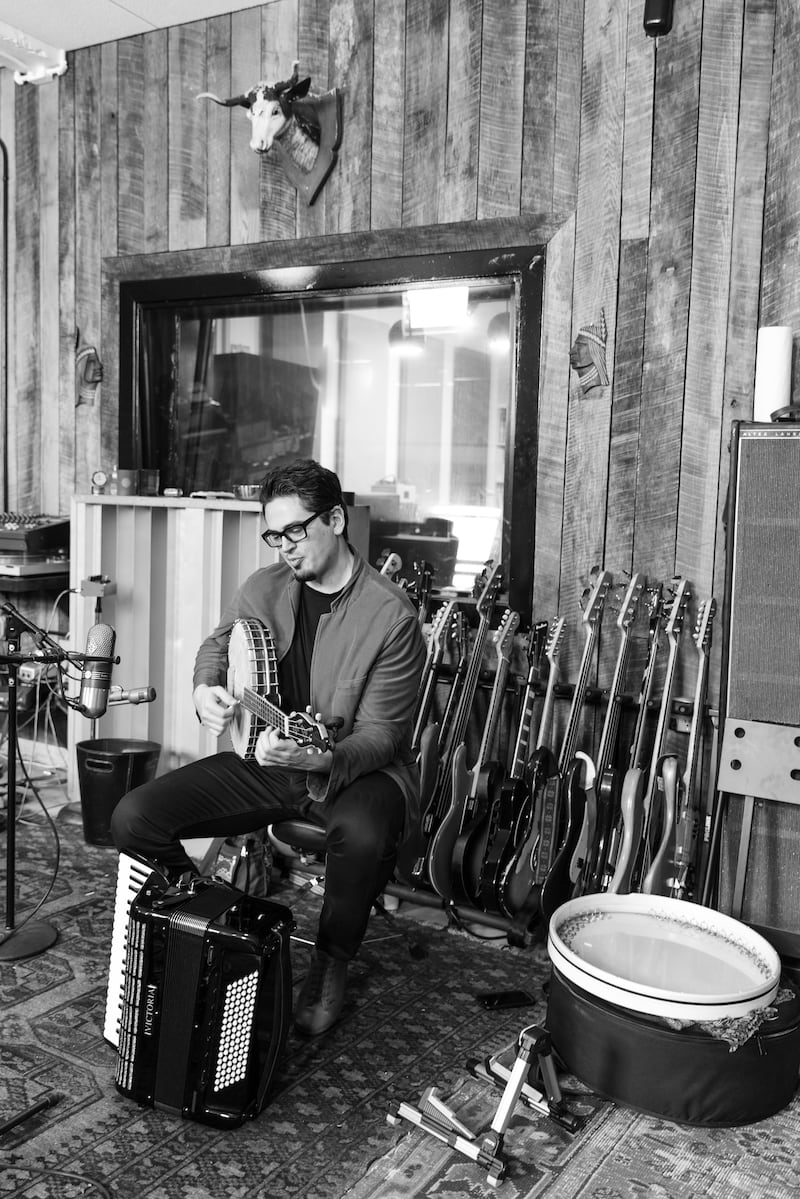
The unparalleled range of instruments he plays also reflects his voracious curiosity and widescreen approach. As well as piano, accordion, harpsichord and organ, Turrisi makes music on various tambourines, frame drums and hand percussion instruments, as well as on guitars, lutes, banjos and mandolins. He is a sui generis one-man orchestra, a paragon of the idea that music can exist beyond taxonomy, that it doesn’t have to be just one thing.
“I mean, the languages of all these genres and instruments are different,” Turrisi says, in his impeccable English. We are sitting in the livingroom of his home in Greystones, in Co Wicklow, surrounded by CDs, high-quality hi-fi equipment, a Shigeru Kawai grand piano and several string instruments and their cases.
“It’s like speaking in English and Italian: I can learn both, and express myself in both, and still be myself. I’ve been exposed to so many musical languages, though, that I struggled for a long time with: ‘What is it that I’m doing actually?’ And then I realised that it goes back to that original idea: I don’t belong to anything, exactly. In a good way. And I’m trying to tell that story in everything I do.”

Not being wedded to any one instrument, style or orthodoxy has led to Turrisi releasing an impressive range of albums as leader and co-leader, all compellingly different and created with a wealth of collaborators and fellow travellers, from the Irish cellist Kate Ellis to the Italian trumpeter Fulvio Sigurtà and the Portuguese drummer João Lobo.
He has also appeared on two duo albums with the peerless American singer-songwriter, banjoist and fiddle player Rhiannon Giddens, the second of which, the appropriately titled They’re Calling Me Home, won the 2022 Grammy for best folk album.
In addition, Turrisi has had a long association with L’Arpeggiata, Christina Pluhar’s popular and pioneering early-music ensemble. More recently, he joined the Silkroad Ensemble, the multinational musical collective founded by the star American cellist Yo-Yo Ma and now led by Giddens – who also lives in Ireland, in Limerick, and was for almost seven years, until 2024, both Turrisi’s musical and relationship partner. Previously he was married to the Irish stone sculptor Helen O’Connell; they have a daughter together.
“I think the way my neurodivergent brain works is that it’s always trying to find patterns,” he says. “It also means that I get really, really obsessed with something and want to learn everything about it. But when I get to a place where I can really do that thing, I always get interested in something else.
“The way they teach you in jazz and classical music, however, is that you have to be a master of your instrument, that it’s a lifetime of dedication, and for a long time I used to get frustrated that I was too much of a jack of all trades. I sometimes thought I should quit and do everything through one instrument – the piano or guitar or whatever.”
Turrisi says he had an epiphany when he started working with Giddens. “Because she trained as an opera singer, and then as a folk musician, and because she’s also played so many different types of music, Rhiannon’s the only musician I’ve ever met where I could wear all my different musical jackets and totally be myself,” he says.
“It was the first time that I realised there is this space where I can be everything that somehow lives within me. I started to make sense of things and crystallise who I am.”
He was brought up by parents who may not have had a strong interest in music but who were encouraging and hard-working. His father, Orlando, came from “a very humble family” and often went hungry as a child, yet he “made himself out of nothing” by getting to university in Palermo; he later started a successful computer-software company. Francesco’s mother, Nina, was employed by a telephone company in Turin; after his older sister was born, she worked in the home.
At 11, Francesco had music lessons at school and “started noodling around” on the piano at home. Spotting his talent and enthusiasm, his mother arranged classical lessons. Turrisi found both the teacher and lessons boring, and he later quit and taught himself guitar; at high school he played electric guitar in student hard-rock bands.
[ Jake Xerxes Fussell: Why I’m bringing my Napoleonic sea shanties to IrelandOpens in new window ]
When he was 15, Turrisi heard the music of Charlie Parker, Sonny Rollins and Ornette Coleman on CD through a magazine partwork on the history of jazz, and he “fell in love with the sound of the saxophone”. He saved money, brought a second-hand tenor and “got completely obsessed”, transcribing solos and having lessons at a jazz school in Turin.
When Turrisi left school, one of his tutors recommended that he study jazz at the renowned Royal Conservatoire in The Hague. “At first my parents were, like: ‘Oh no, no, no, no. That’s insane. We just meant you to play for fun. Being a musician is not a job,’” he says. “But, in the end, after they’d spoken to various people, and I passed the entrance exam, they were very supportive.”
During the summer holiday after his first year, Turrisi suffered a serious setback: every time he went to play the saxophone, the muscles around his mouth shook uncontrollably and he couldn’t hold a note. Eventually diagnosed with a neurological disorder called focal dystonia, he was told to “think about another instrument – or job”.
He chose the former, recommitting to the piano and, remarkably, continuing his studies by passing the conservatory entrance exam for the second time. Increasingly feeling that jazz, as an African-American art form, was not really his history or language, he had by his third year discovered the beauty of 17th-century baroque music on harpsichord and organ, with its strong links to Italy, counterpoint and the improvisatory practice of basso continuo.
Turrisi went on to earn a master’s degree in what was then a highly unusual combination: jazz and early music.
“Jazz is my first love and my mindset; it’s the way I think I approach everything that I do,” he says. “I’m not trying to mix or add things for the sake of it, as often the music doesn’t need that. I’m trying to create colours that show a song or a style in a different light.”
This month, as well as continuing to post on his engaging music and food Substack, Cooking by Ear, Turrisi brings his considerable experience and imagination to bear on his most autobiographical work yet, Vuci: Voices from Sicily.
Partly the result of a trip he made on his own to the island two years ago, during which he visited relatives and his parents’ hometowns, the mostly solo piano album features original compositions, archival field recordings and Sicilian poems, one of which is read in English by the Italian-American actor John Turturro.
The live performance, which was premiered at this summer’s Kilkenny Arts Festival, also features video projections by the Irish artist Laura Sheeran.
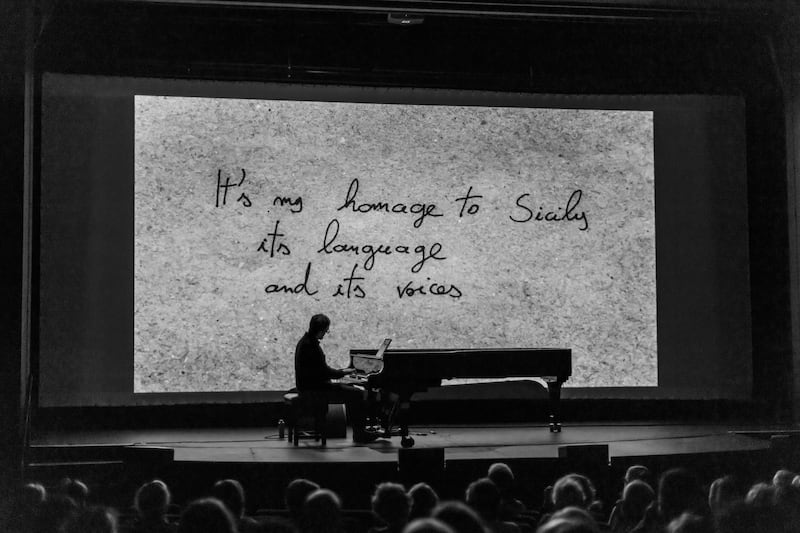
Vuci is Turrisi’s “homage to Sicily, its language and its voices”, in particular “the voices of the people who came before us [and] of the emigrant who struggles to return”.
“There’s definitely a lot of similarities between Ireland and Sicily,” he says. “Not just because both are small isolated places, with a large influence of the Catholic Church, at the edges of Europe. But also in terms of migration, memory and identity. Belonging is a pretty complicated feeling.”
Francesco Turrisi performs Vuci: Voices from Sicily at Project Arts Centre, Dublin, on Thursday, October 22nd; the album will be released digitally and on vinyl via Bandcamp the following day