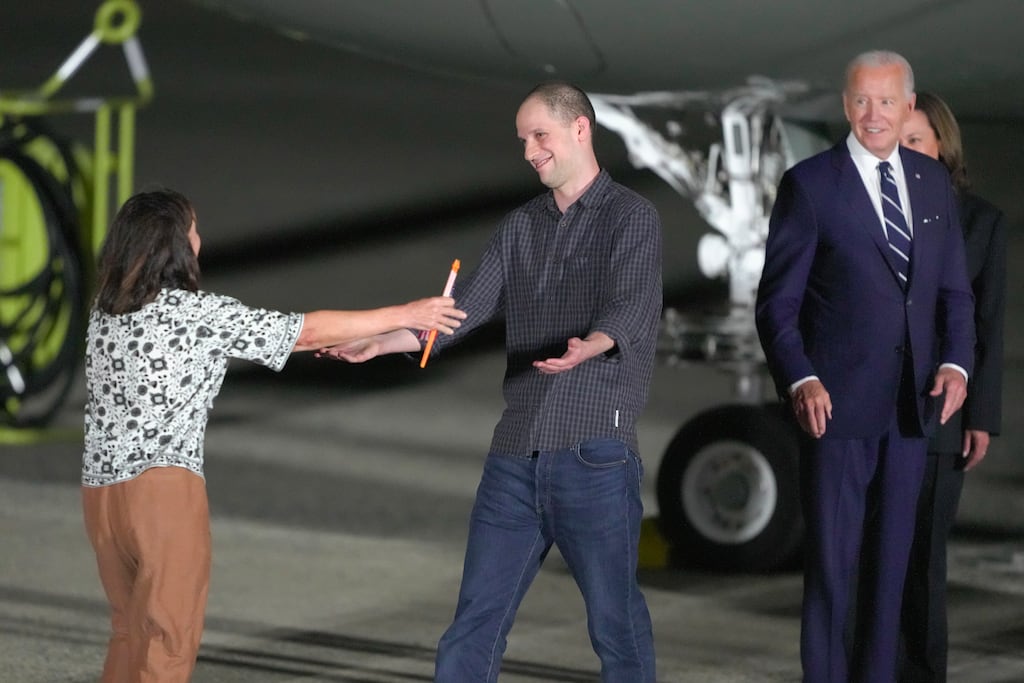
Many of us first saw Evan Gershkovich standing inside a glass cage, facing charges of espionage in Vladimir Putin’s Russia. We might have wondered what he was thinking at that moment. His detention, from March 2023, marked the first time since the Cold War that an American journalist had been arrested on charges of spying inside the country.
Now, free at last, he is finally telling his side of the story, at length and on his own terms. Of the glass cage images, Gershkovich writes of the “performative opening ceremonies” before his legal hearings began where he would try “to present a stoic figure as I always did… knowing this was a chance for my loved ones to see me holding strong.”
His new book is the story of this arrest and sham trial, but also an account of his impressive reporting efforts in the years before his detention; and his upbringing as the child of Jewish Soviet émigrés, torn between two cultures whose people often so deeply misunderstand each other. This memoir is immensely readable, with Gershkovich’s personality, humour and journalistic instinct shining throughout it.
His plan to treat prison like a reporting assignment must have helped. Gershkovich details his efforts to dedicate hours a day to reading and writing, protecting his notebooks and mailing his work out regularly; several of the individuals he encounters in the prison apparatus reference the book he is likely to produce from the experience.
READ MORE


Each encounter offers him new opportunities to speak to individuals - FSB agents; prison guards; political prisoners; judges; Russians willing to fight in Ukraine in exchange for their freedom - who had been off-limits before, and these recounted exchanges are illuminating. Yet none of this is to belittle the suffering that Gershkovich went through and witnessed, which he details calmly - keen to highlight small victories and joys as well as the myriad absurdities and travails.
Gershkovich was born in New Jersey in 1991, two months before the collapse of the Soviet Union. His family history is caught up with present-day Russia’s, for better and worse. His great-grandfather vanished after being arrested in 1937, at the height of Stalin’s purges; thousands of kilometres away and decades later, his mother still sang Gershkovich a Soviet patriotic song as a lullaby. In 2017, he reverse-migrated, leaving the US and a desirable job with the New York Times to relocate to Russia. Gershkovich worked for the Moscow Times and then AFP, before landing at the Wall Street Journal.
[ Russian foreign minister vows to see Ukraine war ‘through to the end’Opens in new window ]

In Russia, he details his growing awareness of invisible boundaries and his efforts to push back at them, despite the constant uncertainty around what could be reported and who was safe. He details being tailed; never knowing if his accreditation would be renewed; wondering when to ignore odd threats circulating, directed at himself, and when to heed them.
“We were constantly alerting ourselves to potential dangers while also trying to make sure we weren’t overreacting. Otherwise we wouldn’t be able to do our jobs. And with each new rise in temperature, we were getting more used to it,” he writes. He remains inside Russia as a growing number of friends depart the country for safer places.
Early on in his reporting career, he learns of the risk of being set up: he is specifically warned not to accept documents from overly eager sources.
Yet this is effectively how his prison time comes about. He is arrested by the FSB in Yekaterinburg, during a second meeting with a source, just over a year after the full-scale invasion of Ukraine. Like all good journalists, his first concern is for his source’s safety - though he soon realises the source, Pavel, is fully complicit in what transpires. Doigralsya - a Russian word which means “you’ve played your way into trouble” - is what Gershkovich thinks as he ends up in prison.
Most of Gershkovich’s incarceration is spent in Lefortovo, on the outskirts of Moscow - a place that is “something of a contradiction: It was Russia’s most notorious prison, reserved for the highest-profile inmates - both Russian and foreign - but it also had the best conditions among Russian detention centres.”
His close relationship with his cellmate there, Seryoga, is emotionally affecting, though this was the one stated part of the book where he blurred reality, given the potential risks (in the author’s note, Gershkovich clarifies that Seryoga is a single composite character, when he actually lived with more than one cellmate). His other close relationships are with his lawyers, who tell him early on that while being cleared of crime is almost impossible, “our real goal is to help you go through this ordeal with dignity”.
At one point, Gershkovich remembers Gulag historian Yury Dmitriyev telling the journalist about his own year in prison: “I don’t make a great tragedy out of that year. I just think of it as a work trip. I’ve gained a better understanding of what my subjects - the people I dig up and write about - were thinking.” He invoked a common Russian saying: “if you’re afraid of wolves, you shouldn’t go into the forest.” Dmitriyev has since been arrested again, and for a much longer term.
Thankfully released, Gershkovich lived to tell the tale - both his own and that of so many others. His resulting book is a gripping, courageous and important one.
Sally Hayden is the author of My Fourth Time, We Drowned and This is Also a Love Story and an Irish Times journalist.
[ ‘We hope he’ll accept’: US invites Putin to G20 summit at Trump golf clubOpens in new window ]