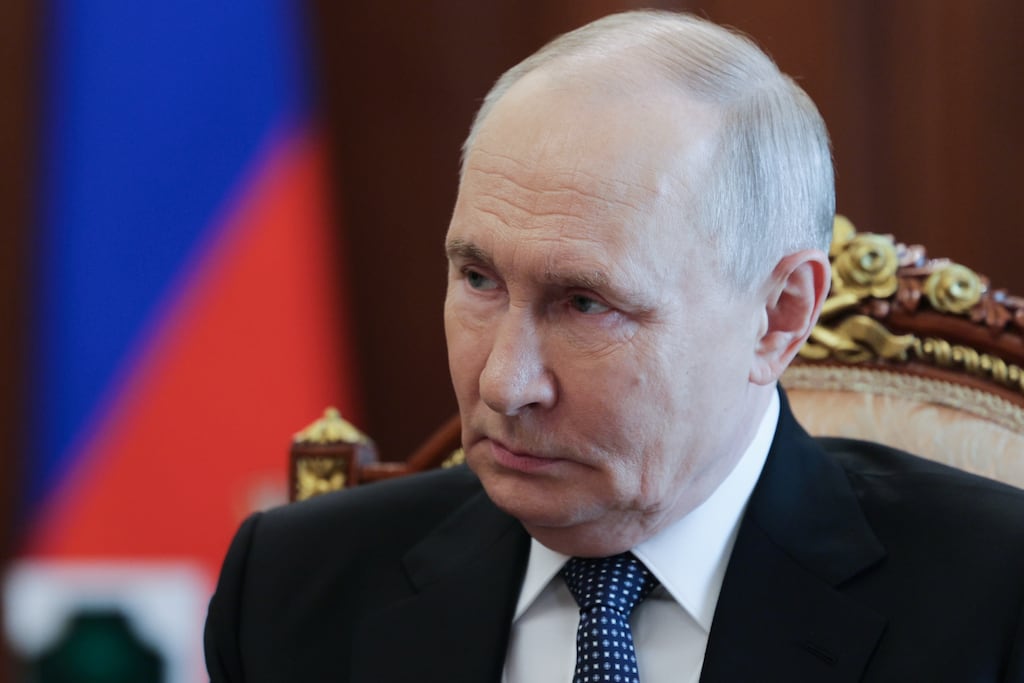
Until February 24th, 2022, Vladimir Putin was not satisfied with the world order. After two years under strict Covid-19 quarantine, the Russian president, according to journalist Mikhail Zygar, had become so isolated that he “completely lost interest in the present” and had become “obsessed” with Russia’s past.
Hanna Notte’s We Shall Outlast Them: Putin’s Global Campaign to Defeat the West picks up on Zygar’s revelation to advance a more complete notion of the autocrat’s mindset, “...confrontation with the West became the central organising principle of the country’s foreign policy”. But to outlast the West, Russia would need to “reinvent itself on the global stage”.
Divided into six parts with 15 chapters, We Shall Outlast Them presents convincing insights into Putin’s statecraft through personal interviews with “men and women in far-flung theatres, some of whom were swept up in Russia’s confrontations with the West, while others became facilitators of Russia’s agenda – sometimes gladly, sometimes unwittingly, sometimes opportunistically”.
Notte is the director of the Eurasia Nonproliferation Program at the James Martin Center for Nonproliferation Studies, and an expert in Russian foreign policy.
READ MORE


After the invasion of Ukraine, Putin sought out ways to ensure he could continue to prosecute the war and avert economic collapse. As Notte writes, “While Russia was scrambling to secure economic lifelines, it was also trying to win support in the global information war.” Regarding the latter, the Kremlin has consistently promoted the idea of itself as the anti-colonial leader against what it calls western “neo-colonialism” on behalf of the Global South.
[ How Vladimir Putin’s refinery dream became a target for UkraineOpens in new window ]
“In addition to its anti-colonial messaging... its attacks on ‘woke’ liberalism gave Russia’s war propaganda a normative veil,” writes Notte. As for its economic stability, Russia has relied heavily on its trading partners (Brazil, China, Egypt, Ethiopia, India, Indonesia, Iran, Saudi Arabia, South Africa, United Arab Emirates), and its “shadow fleet” – the clandestine network of hundreds of vessels it operates to evade sanctions by the G7 countries and European Union.
Notte concludes that Putin’s obsession with invading Ukraine and confronting the West “has disfigured the Russian economy and pushed the country from a tacit dictatorship into the direction of a full-blown one”. And although “Putin may well outlast the West… he has gambled Russia’s future”.