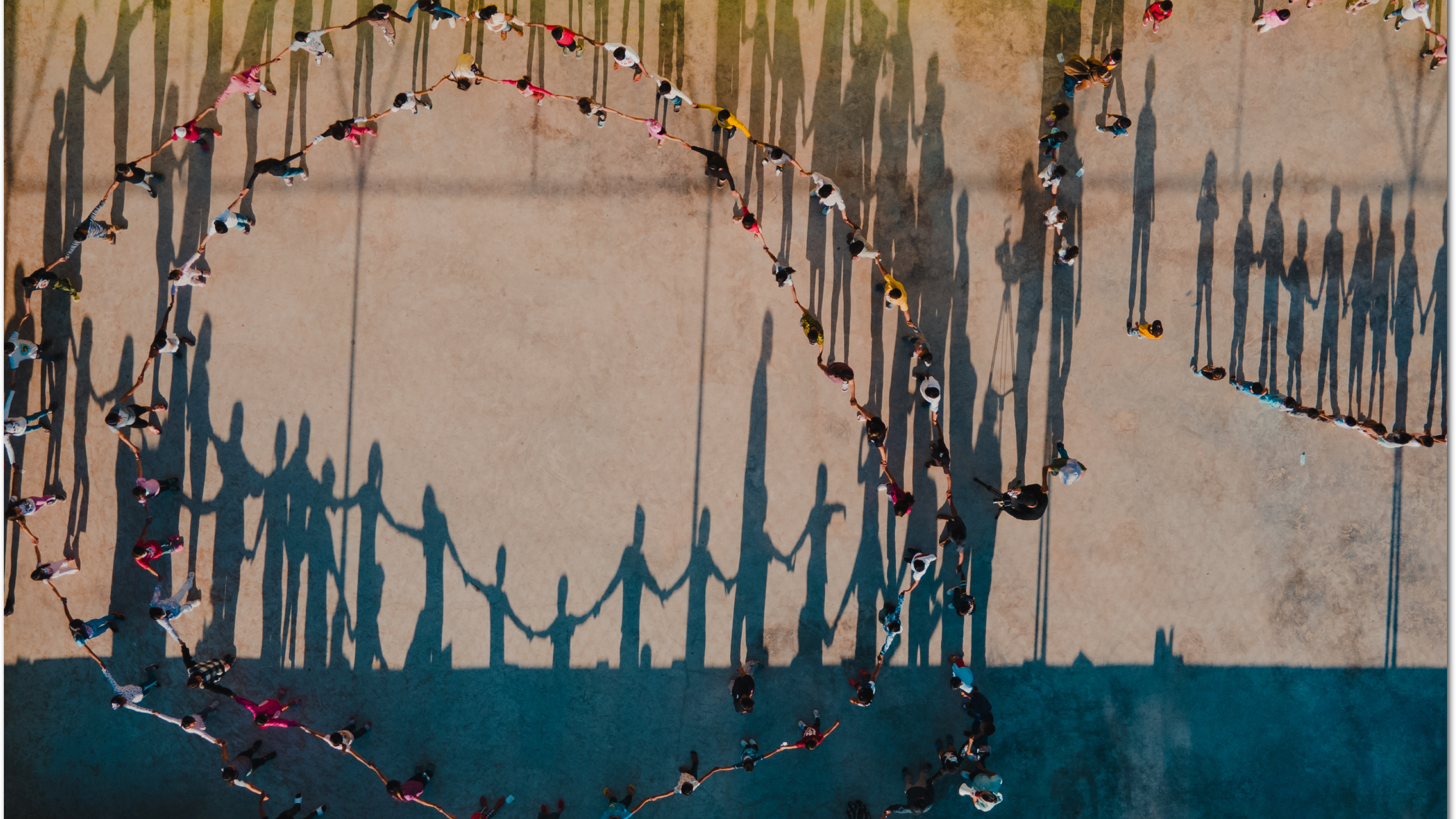
How do you picture peace? War is easy, on so many levels. Conflict has given rise to some of art’s great masterpieces. Francisco Goya’s The Third of May 1808 (painted in 1814) and Pablo Picasso’s Guernica, from 1937, haunt the mind. And what of peace? Doves and rainbows just don’t seem capable of the same sucker punch, even if Picasso’s Dove, a visual essay on peace from 1949, has been reproduced at peace congresses around the world.
Despite the weight of war, the emphasis at the Irish Museum of Modern Art is on paths to peace, but don’t expect to be washed with waves of optimism, or of answers, when you get there.
Kicking off in 1989, the year the Berlin Wall fell, its exhibition Technologies of Peace: Art and Transition in Contemporary Europe (1989-2026) explores art from countries in Europe in which peace processes have paralleled our own.
It is another instalment in Imma’s series of ambitious exhibitions tackling big themes, such as its excellent Self-Determination: A Global Perspective, from 2023, which looked at nation building after the first World War.
READ MORE


Things open with a nicely undermining paradox: Ursula Burke’s brilliant Peach Caryatid stands imperiously at the entrance to Imma’s long corridor gallery. A caryatid is one of those sculpted robed female figures that support the roofs of Greek temples, and here it is a nod to ancient Greece’s role in the development of democracy – the word itself translates as “people power”.
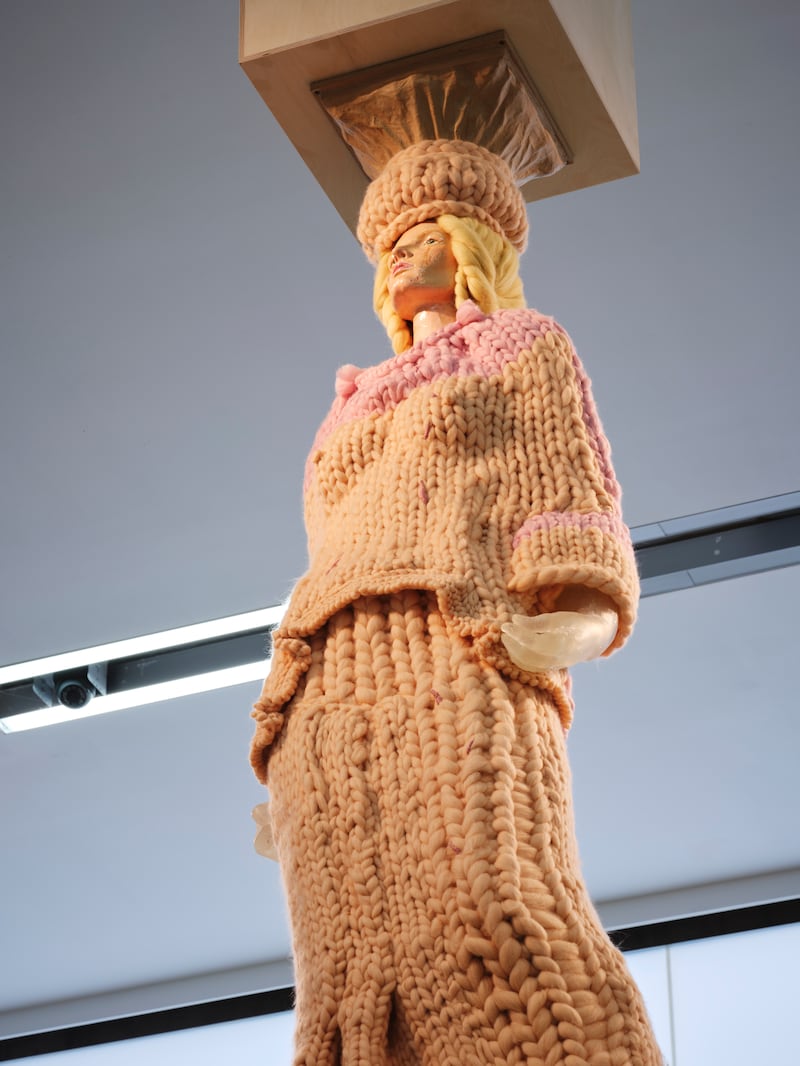
But Burke’s Caryatid is wearing knitted robes, reminding us that support takes many forms, including female labour and the domestic, which are not generally elevated in society’s eyes. Democracy can include exclusion, and a closer look reveals tears running down the figure’s painted face, flecking the peach wool clothes.
This aspect is later taken up in Sanja Ivekovic’s Invisible Women of Solidarity (2009-10), in which the Croatian artist includes the names of the many women who contributed to the Solidarity movement in Poland but whose names were not celebrated.
Threads connect throughout the galleries, but despite being deeply researched, and organised across a series of themes – and perhaps like peace itself – the exhibition feels a little diffuse and hard to pin down.
Just beyond Caryatid, the Cypriot artist Christodoulos Panayiotou shows seven large “pulp paintings”, the colours of which may be vaguely familiar. They are made from mashed-up euro banknotes, with one frame for each denomination.
The notes were obtained from the European Central Bank after they were taken out of circulation – literally demonetised. Again, there is a paradox: while the shared currency is a symbol of the hard-won and harder-maintained unity within the eurozone countries, the whole money-and-the-root-of-all-evil thing is going on.
The calming colours are at odds with the lurid ills that money inspires into the world. War, exploitation, envy, treachery: who knows where these notes went or what their temporary owners did? And here they are now: just faded colour, and art.
If Panayiotou’s work shows the transmutation of paper and ink to money as a matter of collective agreement, or imposition, what, then, about the borders drawn on maps?
Driton Selmani, while on a residency in the UK, had discovered that his native Kosovo was hard to find on online maps. At the time it couldn’t be selected as a destination or as a point of origin. He responded by asking compatriots to draw Kosovo from memory, creating a shifting set of outlines from which he made an embroidered map. In Tell Me Where I Am From (2012), southeast Europe dissolves into unfamiliar and imagined lands.
But borders, once made, must be held. The Slovenian artist Nika Autor’s Red Forests (2022) is a video showing the extent of razor wire at EU borders since 2015. Rita Duffy’s Watchtower 2 (2005-06) imaginatively transforms surveillance towers from the Northern Ireland border lands, post-peace process, as nature reclaims them.
Photographs by another Northern Ireland-born artist, Anthony Haughey, from his Disputed Territory series, take in border regions in Ireland, Bosnia and Herzegovina and Kosovo. Shotgun Cartridges, Armagh-Louth Border (2006) shows how the legacies of violence remain in the land.
Another take on mapping comes from Lana Cmajcanin with 551.35 Geometry of Time (2014), a large illuminated wall piece in which the Sarajevo-born artist traces the outlines of Bosnia and Herzegovina’s borders over 551 years. War, negotiation and the shifts of power and political ideologies demonstrate how borders are both fluid and endlessly contested.
That idea of “endless” is interesting. As a species, humanity appears to live with the myth that we are getting to a fixed destination, and that once the right boundaries, the right governments, the right people and politics bed in, there will be no more war.
But a problem with peace is that we never quite get there, at least not in a way that is everlasting.
Despite the exhibition dates of 1989 to 2026, the timeline that flows across two of the smaller side galleries at Imma begins in 1968, sketching in the global events that informed the politics of our contemporary period.
From the assassinations of Martin Luther King jnr, in Tennessee, and Robert F Kennedy, in Los Angeles, on, it makes for bloody reading. Even in that first decade there was the Battle of the Bogside, in Derry; Idi Amin set up his brutal dictatorship in Uganda; the CIA-backed coup in Chile overthrew the elected socialist president, Salvador Allende; and more than two million people were massacred in Cambodia. The eye slides from injustice to atrocity, and on it goes.
In art this is reflected in works such as Cathy Wilkes’ Untitled (2021), a small installation that lingers on the aftermath of aspects of the conflict in Northern Ireland, such as the Abercorn restaurant bombing of 1972.
Wilkes, who also has an excellent solo exhibition at the Model in Sligo until January 2027, catches subtly at the quieter legacies of violence: fragility, absence and grief.
But look again at that timeline and you see brighter spots. There is the Treaty on the Non-Proliferation of Nuclear Weapons, Greenpeace is founded, the Paris Peace Accords close US involvement in Vietnam, dictatorships end in Portugal and Greece. Hypocrisies are outed, hurts emerge, healings begin. Exhibitions take place and civil-rights movements are born. Is it just that we are more attuned to grim news? Our survival, or so the theory goes, prioritises looking out for danger.
Then there is the matter of context: it’s hard to experience Technologies of Peace without its more positive messages being subdued by the apocalyptic nature of the news these days.
And, going back to that timeline, what is an exhibition, the establishment of a gallery, a cross-border picnic or a song contest in the face of a massacre, a new conflict, a famine? The answer is that, just as people make war, so they make peace. Sometimes they are figureheads and sometimes they simply, but profoundly, sow the seeds of a new idea.
The Polish artist Malgorzata Mirga-Tas works in collaboration with the Romani activist Edis Galushi and members of the Prizren Romani community. The resulting large textile collages draw portraits of Romani luminaries including the social-justice activist, writer and performer Alina Serban and the activist and multimedia artist Luna De Rosa.
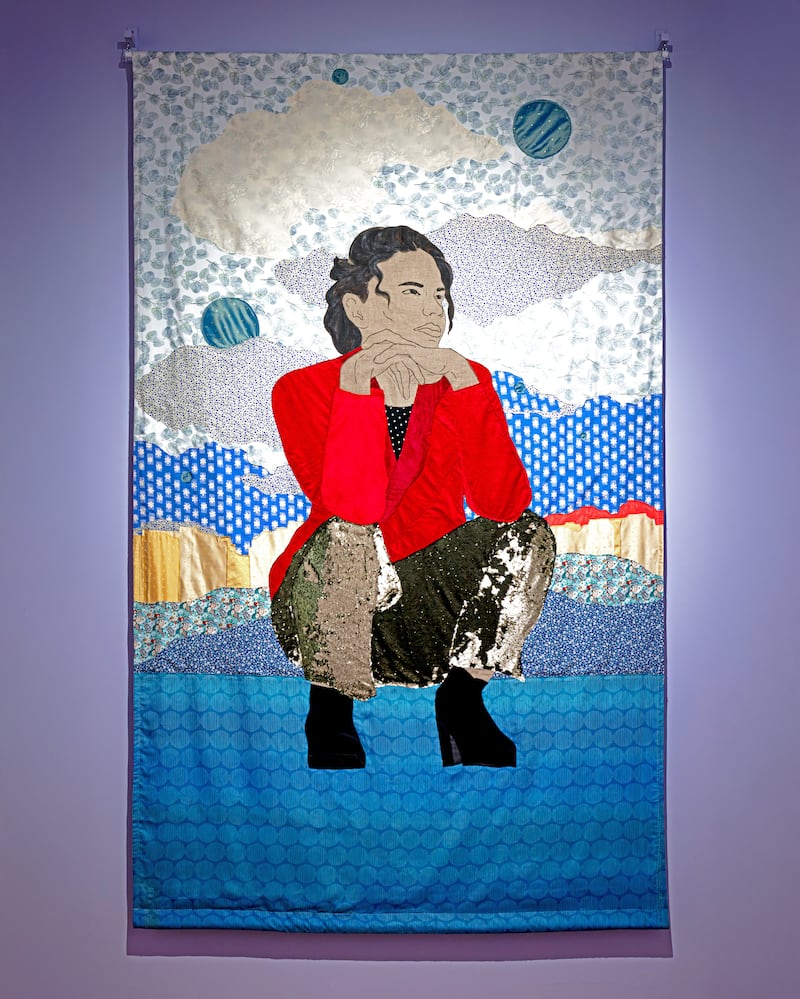
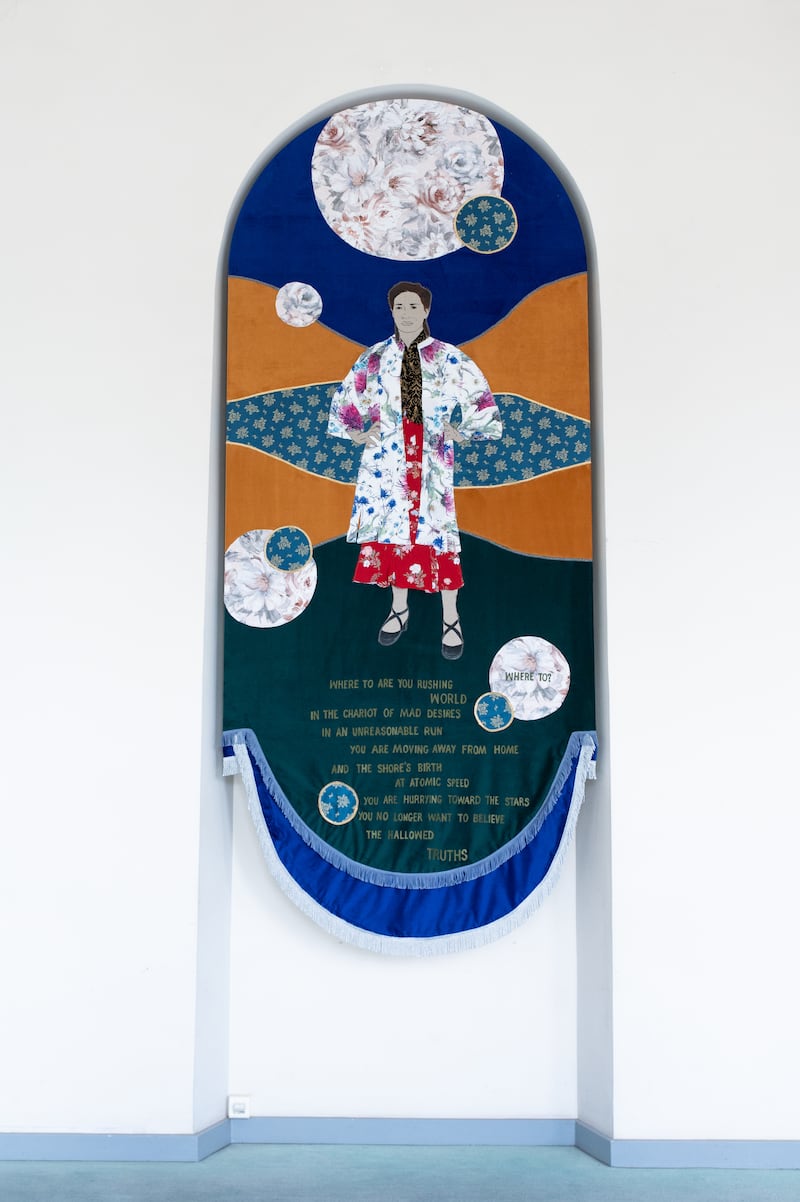
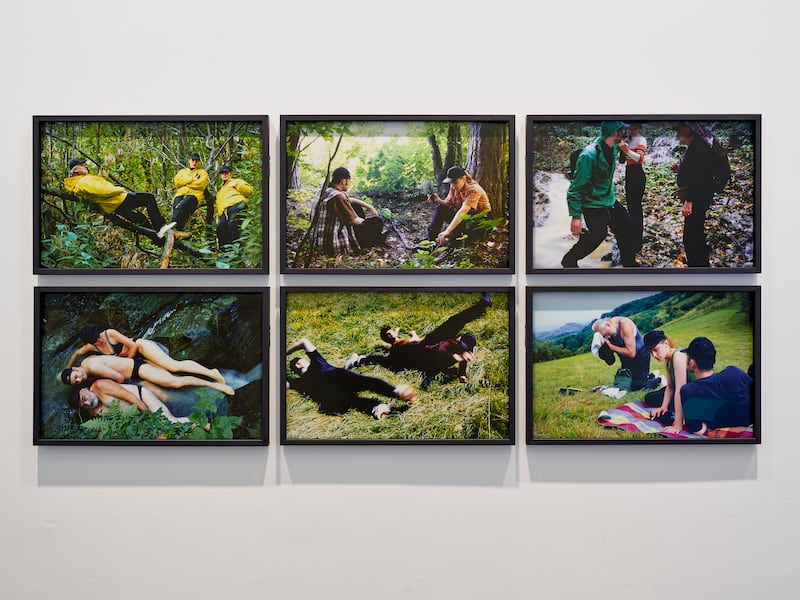
People make peace. Ideas can also come through noticing: Aleksandar Battista Ilic, Ivana Keser and Tomislav Gotovac show a series of works, Weekend Art: Hallelujah the Hill, 1996-2000. As Croatia emerged from communist rule, the trio of artists explored the idea of leisure time by turning their weekend walks into performance-art experiences. There is freedom in these scenes, and joy.
Another element of noticing comes in spotting embedded inequalities. Mladen Stilinovic’s silk banner is painted with “An artist who cannot speak English is no artist”. Made in 1992, it underlines the stranglehold the English language has over the arts globally, consequently inflecting what can be expressed.
Language is there too in Sejla Kameric’s rotating EU/Others (2022), a riff on the signs that appeared at European Union border crossings during the early years of EU integration, in a literal demonstration of “us and them”.
The Bosnia and Herzegovina artist also shows a flashing neon sign that, at a distance, seems to flicker from “Refugees will come” to “Refugees welcome”. Just like the malfunctioning sign, the artist said in 2022, “the society in which we have to discuss whether someone in need (refugees/migrants) should be welcome or not is ill”.

Words matter. Locky Morris’s Comm (1992) takes the small messages written on toilet paper and wrapped in clingfilm before being bodily smuggled by prisoners during the Troubles and makes them monumental.
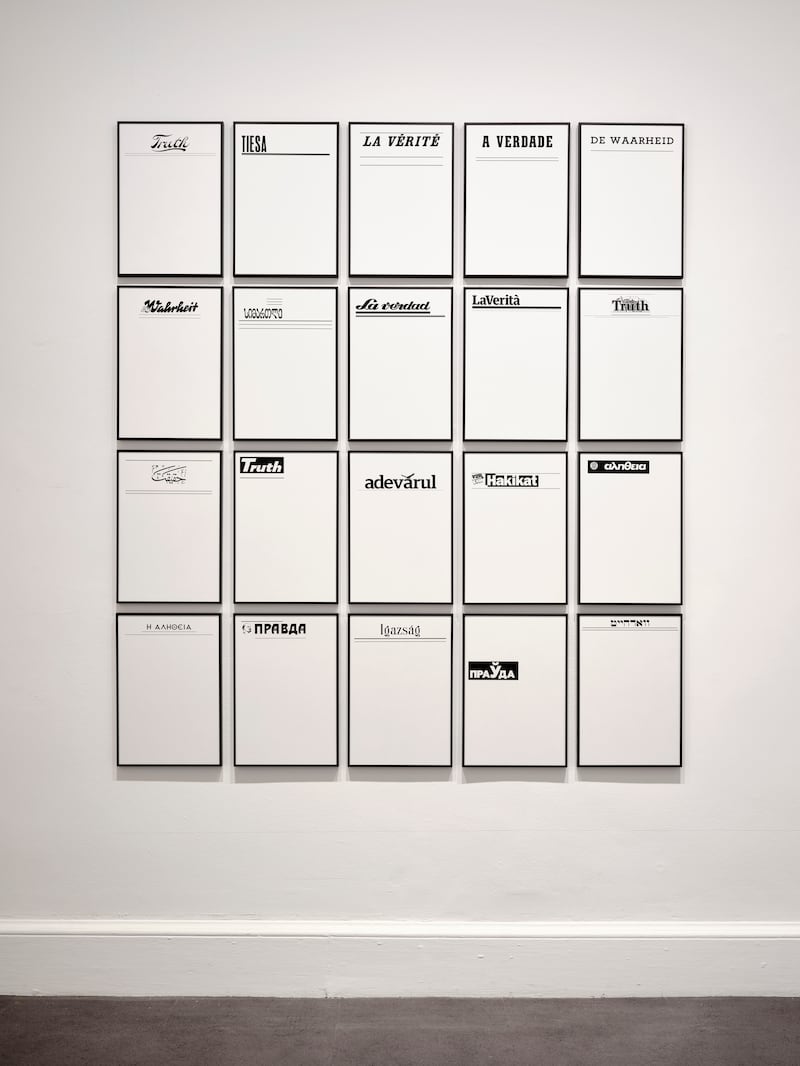
Whatever your political affiliation, there can be no peace without communication. Just beware of anyone who claims to know the “truth”. Alán Carrasco’s History Loves Paradoxes (2023) is a grid of 20 newspaper mastheads, each a translation of the word “truth”. Including La Vérité, LaVerità, Pravda and De Waarheid, the piece nicely balances our desire to know and believe with the dangers of media partisanship, reductive simplicities and absolutism.
The mastheads also underline the diversity of voices within the exhibition, which includes artists from 17 countries, with noteworthy pieces by Frances Hegarty, the Slavs and Tatars collective, and Goshka Macuga.
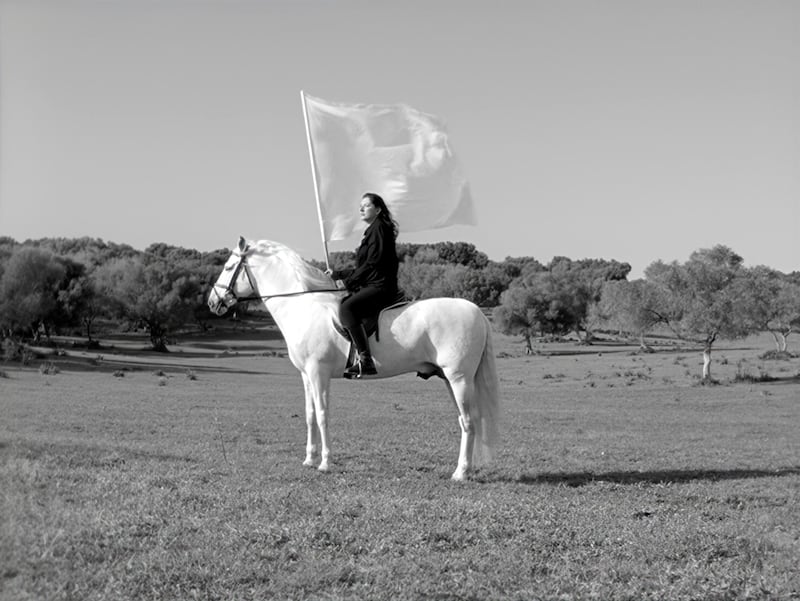
Marina Abramovic’s The Hero (2021) is a little glib – the artist is holding a white banner atop a white horse – yet nonetheless beautiful. More beautiful still is William McKeown’s glowing Open Drawing – Primrose #2 (2003), a reminder that there is still the possibility of renewal, growth, healing and love.
Despite its sprawling nature and occasionally tangled threads, give this exhibition the time and attention it requires. Hope is not naive, and sometimes seemingly small gestures are the results of phenomenal bravery.
As dictatorships and censorship wane and wax, the achievements of peace go beyond bringing these artists together. Instead, they are embodied in the fact that some of these works could have been made at all, and that we are free to see them.
Technologies of Peace, curated by Mary Cremin and Johanne Mullan, is at the Irish Museum of Modern Art, Dublin, until May 9th, 2027